Last year I never even considered crossing Oca and obtaining seed. After all, I knew it was impossible to get successful pollination without multiple varieties, and I was only growing one variety. I knew that flowering was infrequent, and had read that germination was erratic and difficult. All this was received wisdom a year ago.
But I've just found this little fella growing in last year's Oca bed, and as you can see it is not growing from a tuber that dodged the harvest - only roots are growing from the stem. It was close to the spot where a plant flowered last year, so I have to conclude that an Oca has 'done it' on its own.
So why did I carefully lift and check the roots of the plant, and not just terminate it with a hoe, assuming it to be an annoying volunteer in the wrong place? Well, a combination of three separate pieces of information coming together at the right time:
1. Rhizowen's comment elsewhere on this site ' ...mid stylar morphs are, so I've been led to believe, sometimes capable of self pollination.'
2. Rhizowen's post Another Oca Shocker, breaking news that Oca seed can overwinter and germinate outdoors.
3. My own comment on the same post "It would have been so easy to run them through with a hoe thinking they were volunteers..."
Then yesterday, just as in the comment, I found myself standing over a few defenceless Oca seedlings with a sharp hoe poised at their necks. Cogs whirred for a couple of seconds before I decided to check the plants below ground. All were obviously growing from tubers - apart from this one which was clearly not.
No-dig is the other factor that allowed this seed to make it. On a conventional plot it would have been turned 12" underground and would not have had reserves to reach the surface.
This can only have been from a flower that was self-pollinated - from the same plant, and possibly from the same flower, but given the chromosome-scrum that is Oca genetics, it may still produce some useful diversity. So in to a pot you go!
Wednesday, 14 July 2010
Monday, 14 June 2010
Early Sprouter, Early Flowerer.
Yesterday, amongst the Oca / Sweetcorn bed, I was surprised to see one of the Oca was flowering already. In my experience this is a couple of months earlier than usual. Consulting my notebook, I see that the plant is one of a selection that I have tentatively labeled 'Real Seeds Red (Early Sprouting)', as it is the second generation of tubers to be earlier to spring in to life than standard Real Seeds Red.
Perhaps there is a connection - the plant is vigorous, and generally keen to get on with life, and will go on to produce early tubers. But I am realistic enough to look for other explanations. The plants suffered some frost damage after they were planted out, and it may have acted as a stimulus to flowering. This would certainly be a beneficial trait at the end of the growing season - a 'set seed before it is too late' gene.
Alternatively, watering with dilute urine stimulates flowering, or then again it's just a freak occurrence.
It gives me a chance to practice identifying Oca stylar morphs. This seems to be mid styled.
Anyway, the act of flowering is forlorn in this case, as there are no suitable pollination partners available yet (EDIT ...or so I thought - see first comment to this post, from Rhizowen). I looked around with frustration and notice Creeping Woodsorrel (Oxalis corniculata), a cousin of Oca, growing as a weed in the next bed. It's flowering. The flower structure looks very similar to Oca's. Hmmm...
... I'm knowledgeable enough to know that it shouldn't work, but ignorant enough not to be sure it's impossible. There's nothing to loose by trying it.
EDIT During the following two weeks, three more of the same variety flowered, but none of the other varieties. Curious.
I was joking previously when I mentioned Watering with dilute urine
On an unrelated topic, since I read up a bit on vegetable breeding, I seem to be noticing mutations all around me now. Anyone for a bearded strawberry?
Labels:
crossing,
frost-damage,
Oca,
Oca flowers,
varieties
Tuesday, 8 June 2010
Oca / Sweetcorn Bicrop
Various sources state that this is a traditional Andean cultural method, but I cannot find any description of the specific planting patterns used. They may well have used alternate widely-spaced rows of earthed-up Oca with later-planted corn. But I think corn pollination might suffer from the wide spacing, and the unnecessary soil disturbance and labour does not appeal to me.
I want a method that will suit my no-dig 4ft wide beds, and I think block-planted corn with oca near the centre-line of the bed is going to be the most practical approach for me.
Back on the 25th April the preceding crop of grazing rye was hoed off and removed (for strawing strawberries). Small pot-grown Oca were planted out on the same day.
By the 17th May (below) the Oca are established, but looking very lonely. I never like to see bare soil at the best of times, but continuing cool weather has meant the delayed planting of corn, and the Oca have been on their own for longer than expected. I should have left some of the grazing rye crop-debris on the surface to shade my precious humus and reduce surface evaporation.
Spacing for the corn is the tricky bit. I have a theory that if I can get the corn to support the Oca in an upright position, reducing stem contact with the ground, and thus reducing stem tuber formation, the plants will be forced to concentrate all of their energy into bigger tubers around the roots (see Tubers- big and few, or small and many), and Oca - Be Erect not Supine!). The corn will have to be reasonably close-planted to do this, but must be far enough apart to admit light to the Oca - a fine balance.
6th of June, the sweetcorn are ready to go...
14th September. The corn has all been harvested, and the plants cut back to admit more light to the Oca during the shortening days.
Update, 2010 Oca harvest here.
I want a method that will suit my no-dig 4ft wide beds, and I think block-planted corn with oca near the centre-line of the bed is going to be the most practical approach for me.
Back on the 25th April the preceding crop of grazing rye was hoed off and removed (for strawing strawberries). Small pot-grown Oca were planted out on the same day.
By the 17th May (below) the Oca are established, but looking very lonely. I never like to see bare soil at the best of times, but continuing cool weather has meant the delayed planting of corn, and the Oca have been on their own for longer than expected. I should have left some of the grazing rye crop-debris on the surface to shade my precious humus and reduce surface evaporation.
Spacing for the corn is the tricky bit. I have a theory that if I can get the corn to support the Oca in an upright position, reducing stem contact with the ground, and thus reducing stem tuber formation, the plants will be forced to concentrate all of their energy into bigger tubers around the roots (see Tubers- big and few, or small and many), and Oca - Be Erect not Supine!). The corn will have to be reasonably close-planted to do this, but must be far enough apart to admit light to the Oca - a fine balance.
6th of June, the sweetcorn are ready to go...
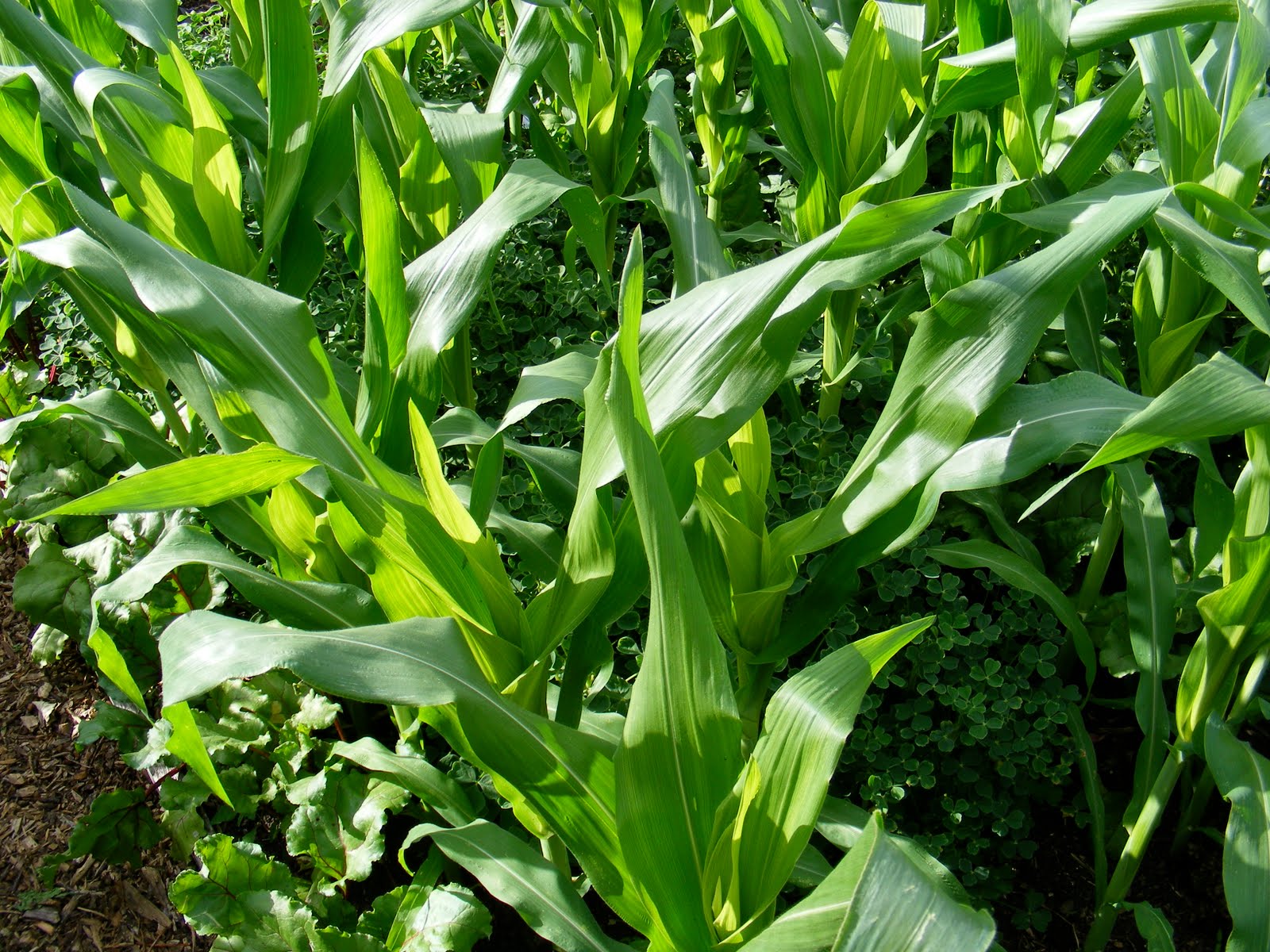
...and are spaced on a grid of about 1ft across the bed and slightly more along the bed. The Oca sit on the same grid so that each is surrounded by four corn. Just visible are beetroot plugs added along the edges of the bed to complete a three-way polyculture, and utilise the extra light available at the sides.
Just one week later (13th June), all three crops are putting on amazingly fast growth. Notice the unusually early Oca flower.
By the 20th of June, just 14 days after planting the corn, the canopy is about to close. So far, the spacing seems to be working just right, and the weeds won't get a look in.
4th July (4 weeks after planting corn) Stand well back everyone!
Keeping a log with photos and dates really highlights how quickly crops grow in midsummer. The Cylindra beetroot are already of a useable size, the corn is waist high, and the Oca foliage is relentlessly advancing towards the edges of the bed.
We've had consistently hot sunny conditions for the last few weeks, and I think the Oca is probably benefiting from the partial shading of the corn.
23rd July. The corn is above head height and showing signs of flowering. Some beetroot have already been harvested, and the Oca is giving full ground cover to the bed.
Weed suppression is absolute.
With the continuing drought, I've been forced to water a few times, and strong winds flattened some of the corn, so they have been staked, but otherwise the bed has looked after itself just fine.
20th August. The corn is cropping. It's averaging two good-sized cobs per plant, so six per linear foot of bed. The beetroot have all been eaten.
4th July (4 weeks after planting corn) Stand well back everyone!
Keeping a log with photos and dates really highlights how quickly crops grow in midsummer. The Cylindra beetroot are already of a useable size, the corn is waist high, and the Oca foliage is relentlessly advancing towards the edges of the bed.
We've had consistently hot sunny conditions for the last few weeks, and I think the Oca is probably benefiting from the partial shading of the corn.
23rd July. The corn is above head height and showing signs of flowering. Some beetroot have already been harvested, and the Oca is giving full ground cover to the bed.
With the continuing drought, I've been forced to water a few times, and strong winds flattened some of the corn, so they have been staked, but otherwise the bed has looked after itself just fine.
20th August. The corn is cropping. It's averaging two good-sized cobs per plant, so six per linear foot of bed. The beetroot have all been eaten.
14th September. The corn has all been harvested, and the plants cut back to admit more light to the Oca during the shortening days.
Update, 2010 Oca harvest here.
Labels:
bi-cropping,
Oca,
polyculture,
Sweetcorn,
trials
Subscribe to:
Posts (Atom)