Showing posts with label Oca flowers. Show all posts

Tuesday, 1 November 2011

Saving True Oca Seed — It's in the Bag!

My previous attempts at collecting Oca seed have been frustrated by circumstances, but I've finally made the vital step in oca one-upmanship. And here's the proof...
... several tiny seeds safely retained in their capture-bag, along with their spent seed pods. So why it it so tricky?

Well, firstly Oca is an outbreeder; you will need to have multiple varieties (the more the better) for a good chance of compatible flower-types occurring simultaneously (flowering is sporadic). Grow them mixed closely together to improve chances of natural pollination.

Wait for (or perhaps try to induce) flowering. This can happen anytime during the growing season, but seems to be linked to available moisture or (my theory) high air humidity, as I've noticed that flowering reliably occurs whenever there is dew in the mornings. It would be interesting to confirm this using a misting system, but anyway, flowering seems far more common in wetter parts of the world, and definitely does not happen during hot dry weather.

Next, you need to be able to identify the three flower types, and understand the legitimate pollination combinations. There is a good explanation of this from Rhizowen, but here it is in very simple terms.
It's all about the pointy bits in the middle of the flower (I did say it would be simple!).

In this Oca flower, the longest pointy bits are pale yellow, while the shorter ones are dark yellow...
...so this is 'long-styled'. The pale yellow parts are female, while the darker yellow are male, producing pollen.

So what would you call this one where the pale yellow parts are shorter than the others?
...yup, short-styled.

And to make the full set, here is the mid-styled model...
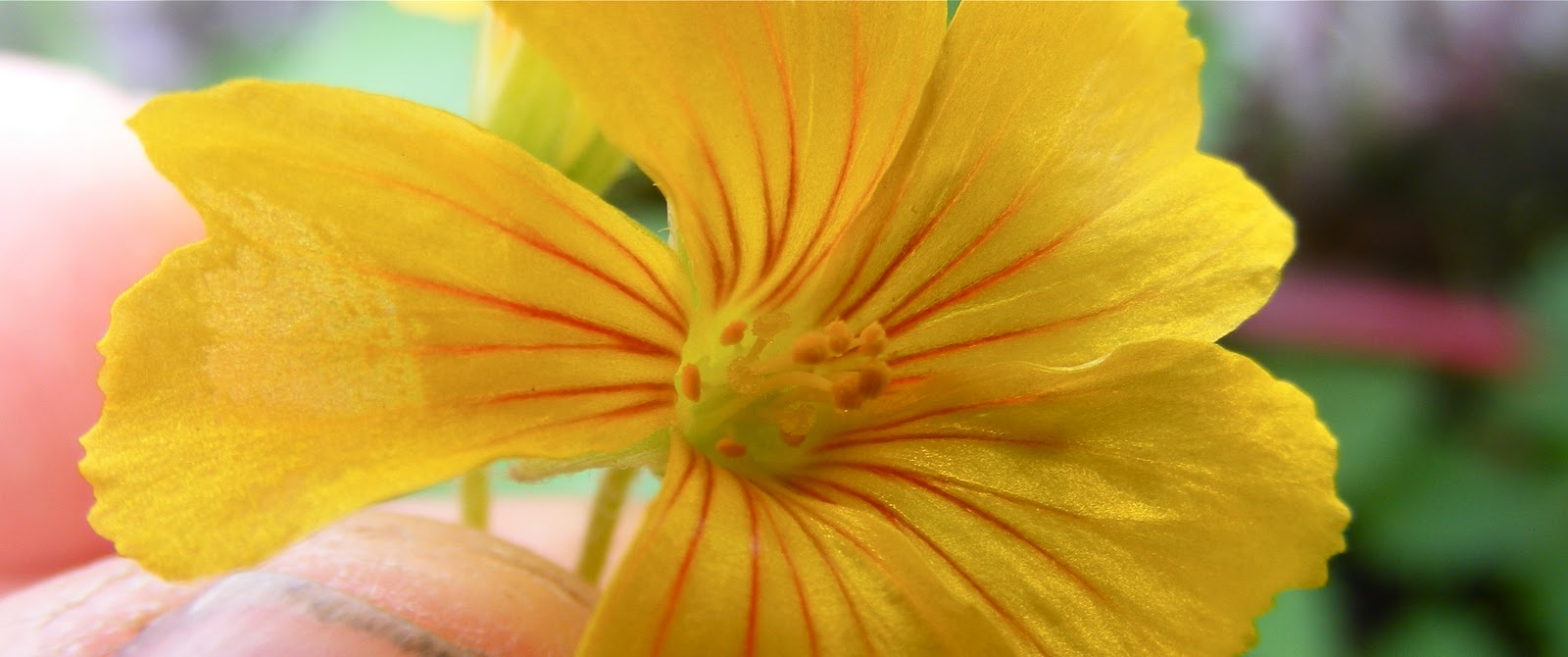
Now comes the tricky bit. Flowers of the same type cannot pollinate each other, and even if you have two different types of flower, the pollen must come from the specific length of male pointy bit that matches the length of the female pointy bit being pollinated. Phew, that's the end of the technical bit.

Actually it's not strictly necessary to know all that, unless you plan to do the pollination manually. If you have bees, hoverflies, or other natural pollinators, you can just sit back and wait for the next stage. However, I have obtained higher levels of success from manual pollination (5 to 7 seeds from each flower compared with 1 to 3 when leaving it to nature).

If you take the route of manual pollination, you will need to attend to your plants during the early afternoon when the flowers are most likely to be open.

This year I have marked all of the manually pollinated flowers with brightly coloured electrical tape so that they don't get lost in the still-expanding mass of foliage.
After a week or two, it's possible to differentiate between fertilised and unfertilised pods. The photo below shows one of each; the top one is swollen, and looks like it has a full compliment of seed inside. The lower one is limp, and will soon drop from the plant, confirming that it has not been fertilised.
At this stage it's okay to leave fertile pods, safely highlighted with coloured tape, on the plant to mature. But this is not the time to go on holiday to Marbella for a fortnight. It's necessary to check every couple of days for a change in appearance in the pods; they take on a more muscular appearance, sometimes puckering up their nose ready to explosively discharge their seed. This one is ready to pop at any time...

At this point I add polythene catch bags...
...and with luck, after a day or two the pods will have blown apart, shooting their tiny brown seeds into the corners of the bags...

I'm getting a few more every day, so if the weather holds I should be well provided with seed for a mass sowing and selection next year.

Out of interest, not all Oca flowers conform to one of the three regulation patterns; here's a double flower that's never going to get pollinated naturally...
.

Friday, 5 August 2011

Wildlife in the Oca, Friend or Foe?

I was initially alarmed by this chap...
...(and several of his mates) browsing amongst my Oca. I watched for a few minutes, and noted that they left the Oca plants untouched, but laid waste to surrounding weeds - a situation that suited me fine. Obviously they qualified as good-guys, and there would be no need for a messy manual squashing session.
It seems it's the caterpillar of the Cinnabar moth. Some research revealed that they are used as a biological control of their favorite food plants, ragwort and groundsel. Apparently after consuming all available ragwort and groundsel in the area, they may become cannibalistic. I do appreciate workmen that tidy up afterwards!

With some Oca flowering, I've been scrutinising stylar arrangements...
... and have noticed a lot of these tiny thrips or thunderbugs in the flowers. They suck sap from plant cells, and are considered a pest. It's possible that they could spread viruses, but on the other hand they may provide some pollination even though they seem disinclined to fly much between flowers. On balance I prefer to leave them be.

These hoverflies are much more energetic pollen stirrers ...
... and given the compatible flower types available at the moment, I'd better start keeping my eyes peeled for fertile seed pods.

Surely this will be the year!

Saturday, 18 September 2010

The Flowering of Oca

If you are lucky enough to have had Oca flower, you can probably contribute valuable information to help solve a mystery. Let me explain.
The most promising method to obtain day-length neutral strains of Oca is to look for the trait in the variable plants grown from true seed rather than clones grown from tubers.
Seed can be obtained if you can persuade more than one variety of Oca to flower simultaneously, but that is more easily said than done as Oca may, or may not oblige in that department depending on unknown mystery factors.
One gardener in one location cannot see the factors, or at least not this gardener. Observations on flowering periods are needed from a wide geographical and climatic range - then hopefully a pattern will be evident when viewed overall.

Do your bit for the Oca breeding effort, push back the frontiers of the Oca-unknown - join the Radix Root Crops facebook group, and contribute to the discussion 'Flowering Ocas: Where and When'.

Even knowing that Oca is not flowering in a certain location is useful information.
If you're not into facebook, leave a comment here about your flowering (or non-flowering) Oca. Dates, location, recent weather... anything that you think might be relevant.

Come on Oca flowers out there  - show yourself!


The tiny flower buds grow from leaf axils near the growing tips of stems.


Wednesday, 14 July 2010

Oi! My Oca's Been at It!

Last year I never even considered crossing Oca and obtaining seed. After all, I knew it was impossible to get successful pollination without multiple varieties, and I was only growing one variety. I knew that flowering was infrequent, and had read that germination was erratic and difficult. All this was received wisdom a year ago.
But I've just found this little fella growing in last year's Oca bed, and as you can see it is not growing from a tuber that dodged the harvest - only roots are growing from the stem. It was close to the spot where a plant flowered last year, so I have to conclude that an Oca has 'done it' on its own.

So why did I carefully lift and check the roots of the plant, and not just terminate it with a hoe, assuming it to be an annoying volunteer in the wrong place? Well, a combination of three separate pieces of information coming together at the right time:
1. Rhizowen's comment elsewhere on this site ' ...mid stylar morphs are, so I've been led to believe, sometimes capable of self pollination.'
2. Rhizowen's post Another Oca Shocker, breaking news that Oca seed can overwinter and germinate outdoors.
3. My own comment on the same post "It would have been so easy to run them through with a hoe thinking they were volunteers..."
Then yesterday, just as in the comment, I found myself standing over a few defenceless Oca seedlings with a sharp hoe poised at their necks. Cogs whirred for a couple of seconds before I decided to check the plants below ground. All were obviously growing from tubers - apart from this one which was clearly not.

No-dig is the other factor that allowed this seed to make it. On a conventional plot it would have been turned 12" underground and would not have had reserves to reach the surface.

This can only have been from a flower that was self-pollinated - from the same plant, and possibly from the same flower, but given the chromosome-scrum that is Oca genetics, it may still produce some useful diversity. So in to a pot you go!

Monday, 14 June 2010

Early Sprouter, Early Flowerer.


Yesterday, amongst the Oca / Sweetcorn bed, I was surprised to see one of the Oca was flowering already. In my experience this is a couple of months earlier than usual.  Consulting my notebook, I see that the plant is one of a selection that I have tentatively labeled 'Real Seeds Red (Early Sprouting)', as it is the second generation of tubers to be earlier to spring in to life than standard Real Seeds Red.

Perhaps there is a connection - the plant is vigorous, and generally keen to get on with life, and will go on to produce early tubers. But I am realistic enough to look for other explanations. The plants suffered some frost damage after they were planted out, and it may have acted as a stimulus to flowering.  This would certainly be a beneficial trait at the end of the growing season - a 'set seed before it is too late' gene.
Alternatively, watering with dilute urine stimulates flowering, or then again it's just a freak occurrence.


It gives me a chance to practice identifying Oca stylar morphs. This seems to be mid styled.

Anyway, the act of flowering is forlorn in this case, as there are no suitable pollination partners available yet (EDIT ...or so I thought - see first comment to this post, from Rhizowen). I looked around with frustration and notice Creeping Woodsorrel (Oxalis corniculata), a cousin of Oca, growing as a weed in the next bed. It's flowering. The flower structure looks very similar to Oca's.  Hmmm...


... I'm knowledgeable enough to know that it shouldn't work, but ignorant enough not to be sure it's impossible. There's nothing to loose by trying it.

EDIT During the following two weeks, three more of the same variety flowered, but none of the other varieties. Curious.
I was joking previously when I mentioned Watering with dilute urine but these plants are benefiting from this feed intended for the interplanted sweet corn, and it's the only difference in cultural treatment which I can think of that could be a factor. Anyway, all attempts at pollination whether by other mid-styled oca, or by unlikely motley related species have been unsuccessful so far. I'm now watching out for any official legitimate pollinators coming in to flower.  Work commitments are making it impossible for me to regularly patrol the plot during the crucial period around midday when flowers open, so there's a fair chance I'm going to miss the vital moments.

On an unrelated topic, since I read up a bit on vegetable breeding, I seem to be noticing mutations all around me now. Anyone for a bearded strawberry?