Showing posts with label Ulluco. Show all posts

Tuesday, 3 January 2012

Ulluco — It's How You Sell It

Managing people's expectations can make a big difference when they are introduced to a new crop. If you say to someone "Ulluco, a tuber a bit like a potato", then straight away you are setting up a mismatch between their mental image and the diminutive reality.
Here are the tubers I lifted last week...
... not exactly huge, but better than last year's lot which were hit by early frost.
On the other hand if you say it's a low-growing plant with really nice succulent edible leaves, which can be grown under taller crops (so don't take up space), and which give a bonus harvest of beautiful little brightly-coloured bean-like tubers, then no-one is going to be disappointed.
Well, not unless the plants are frosted before they can tuberise, that is.
So with my expectations well and truly managed, this year I grew them along with fellow 'minor' root crop Chinese artichokes along with garlic and climbing beans (have a look) and I think they benefited from all the extra watering that was lavished on the primary crop.  What they definitely did not benefit from was the smothering effect of various volunteer Oca plants that came up amongst them.

However, they survived, and they did it without any real care or attention during the whole growing season.

Something for nothing—the type of crop I have space for.

Sunday, 13 November 2011

November is Tuber Time

Most conventional vegetable crops are on the wane by now, but the short days mean only one thing for Oca...
...make tubers, and make 'em fast! These stem-borne Oca tubers are getting noticeably bigger every day, and I've no doubt that those underground are similarly ascendant.  In fact, in places I can see the soil surface starting to heave upwards from the pressure of the swelling crop.

A hands-and-knees survey of the plot discovers plenty more underground action. This is the Ulluco doing its best to tuberise...
...and doing better than last year, when they were already frosted by now.

Chinese artichokes tubers are also bulking up. These are from the plants used as ground cover under climbing beans in the 'root crops as ground cover trial'.

And scraping around the base of a Yacon in the 'Not the Three Sisters' bed reveals sizable storage tubers.
All this bodes well for bumper crops. But of course, a frost could easily put a damper on that.

Unfortunately someone else has noticed all this underground fodder. This is a large excavation on one side of the 'All-Tuber Polyculture Mound'...
Oca, Chi-chokes, and bits of Yacon are scattered around. Rats could be the culprits, although a lot of the uncovered tubers have not been eaten. Then again maybe it's a fox. Anyway, the damage has put a halt to a lot of the plants in the mound.

Grrrrr!

Wednesday, 11 May 2011

'Minor' Root Crops as Ground-Cover in Polycultures

Oca can provide extremely effective ground-cover within a vegetable polyculture, as demonstrated with tomatoes, or sweetcorn. But how about using other minor root crops in the same role?
Ulluco  for example...
Sprouting Ulluco tubers lifted from storage in sand, 15th March.


... and Chinese artichoke (below) both give cover earlier in the growing season, lasting through to the first frost. And being very definitely 'minor' in productivity, I can't justify either of them as a monocrop; my basic criterion is that bed-space must produce a decent kitchenable yield, preferably with the minimum of labour.
Chinese artichoke tubers

But even if they don't produce much crop, at least they can reduce my weeding and watering by acting as a living mulch around other more productive crops .
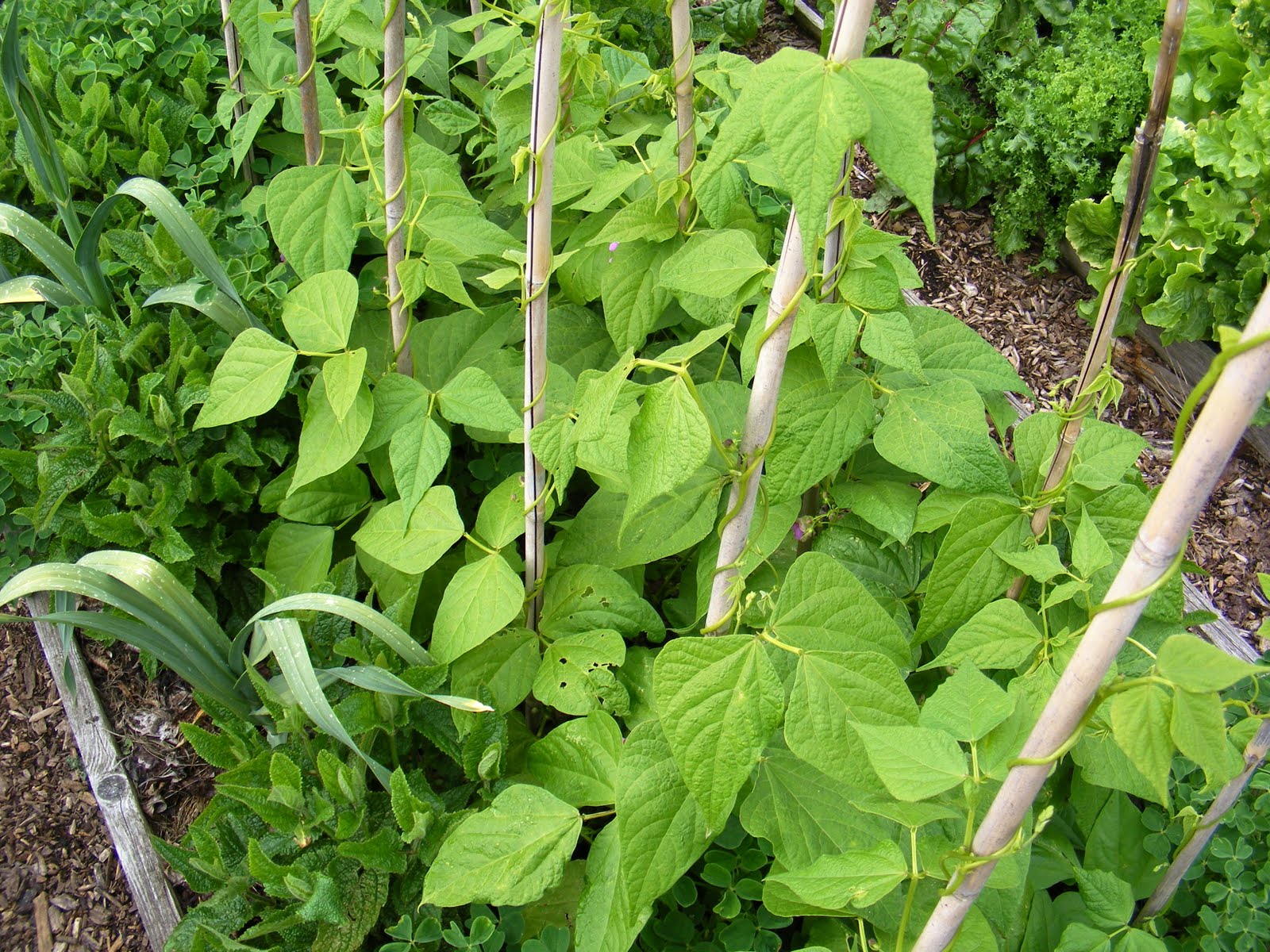
I'm going to give them both a try growing with climbing French beans, plus garlic and elephant garlic.

Last autumn the bean-bed-to-be was cleared too late to establish an overwintering green-manure crop, so without digging, I planted it with garlic and elephant garlic, then added autumn leaves, retained with steel mesh. Here's the scene in late winter...

In early April the mesh is removed, and the ulluco and Chi-chokes (previously started in pots in an unheated greenhouse) are added between the garlic. Plastic sheet is placed down the centre of the bed to warm the soil for the beans.
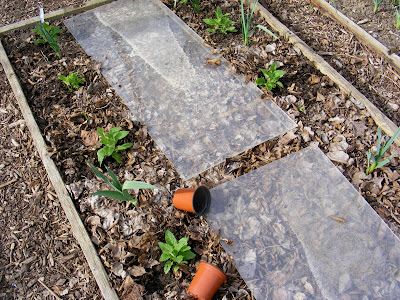
Pot-grown Chinese artichokes planted out, 3rd April
Initially, there's a lot of slug-damage to the ulluco, especially those with green stems. The red colouration of some varieties seems to offer protection against pest damage.

Slug-damaged ulluco, 15th April
Removing the plastic sheet, allowing access to foraging birds, seems to improve matters.

Bellow, supports added in readiness for the French beans. The weather is hot and dry, so the mulch is topped up with a layer of grass cuttings.
5th of May, (below) the French beans, started previously indoors in root-trainers, are planted out.

French beans added, 5th May
Just after the photo was taken I pinched out the tips of the Chinese artichokes to encourage more side growth. There's no sign of any weeds getting through the autumn leaves yet (apart from the odd oca volunteer - which will be tolerated for now).

All done! If the ground-cover crops expand to give full cover before the leaf mulch breaks down, then there should be no more work involved apart from harvesting. My one concern is that there may be excessive competition for moisture between the crops if there is a dry summer, but we shall see.

Update 9th June. First produce from the system is garlic...
... no complaints there.

Meanwhile, the beans are twining, and the ground cover is closing up well...
The Chi-chokes have just about reached full cover, but the Ulluco are slightly slower.

Update 30th June.  Next — the elephant garlic has died back, so harvest time:
Some have only formed rounds rather than cloves, probably as they were slightly late getting planted. Lifting them caused a bit of disturbance to the Chi-chokes' roots, but hopefully no serious harm done.

Update 3rd August. The beans have been cropping well for about four weeks. The ground cover is complete, and virtually no weeds have made it through.

Update 22nd November. The beans and their supports have been removed. The first picking of tubers, a square foot of the bed, delivers enough Chinese Artichokes for a meal...
 I feel a stir fry coming on.

Update 16th January. I'm continuing to lift tubers as they are needed in the kitchen. As you can see there are plenty of volunteer Oca to be had amongst the Chinese artichokes...

The Ulluco have now been killed by frost, so I'm also lifting them now. They've done better than last year, but that's not saying much.

.

Saturday, 11 December 2010

Unimpressive Ulluco Harvest

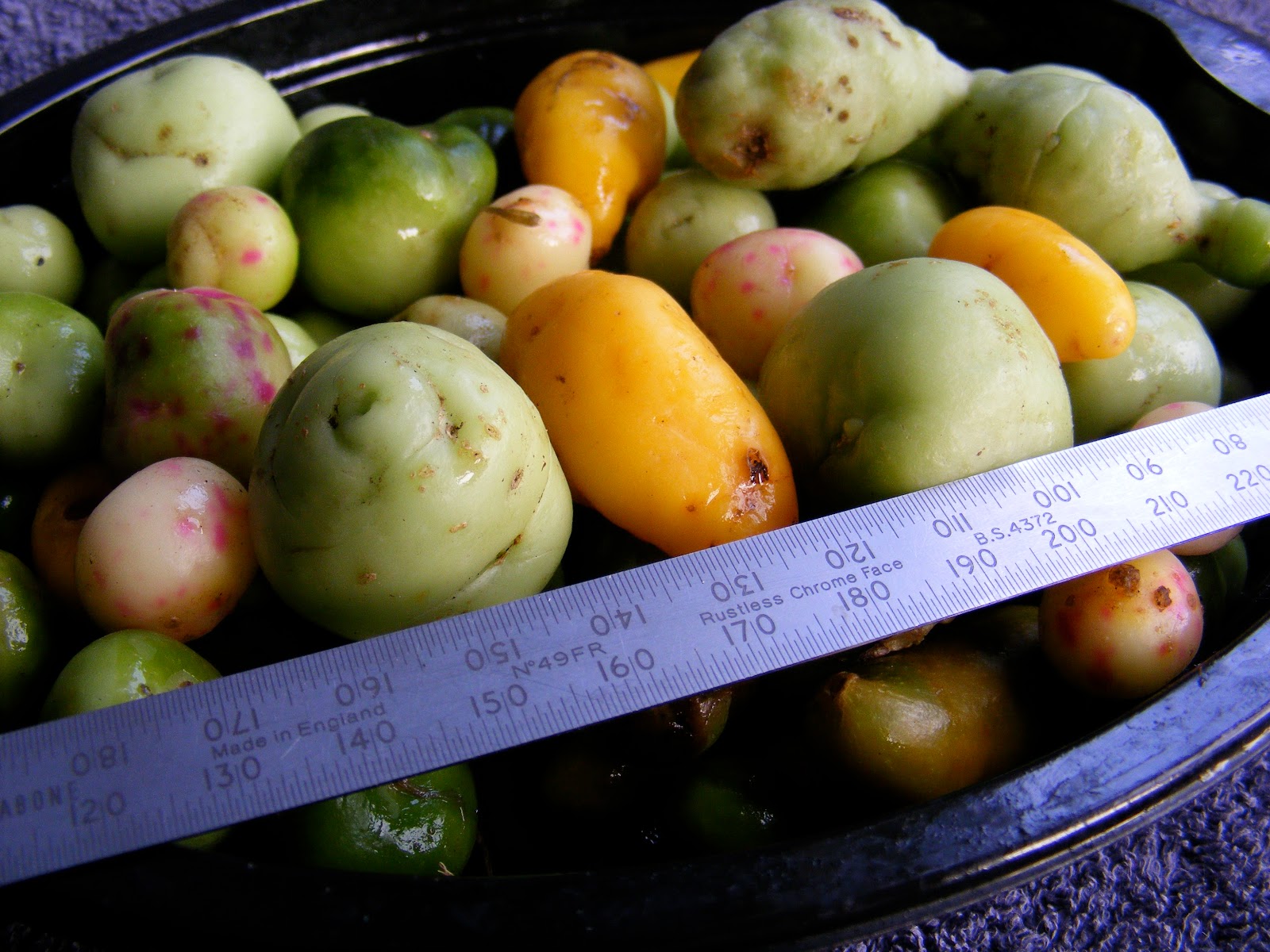
Like the Oca, my Ulluco plants were hit by a light frost back in October (have a look).  Some plants died, while a few hung on to life until the recent really cold weather set in. The other day, I decided that I may as well see what was below ground.  I was expecting a poor crop, and that's just what I got...
... a handful of tubers not much bigger than beans. So no need to fetch the wheelbarrow then.

This handful wouldn't even make one meal, but they're satisfying enough as eye-candy to reward the light work of lifting them. They are just too good-looking to give up on yet.  At least I've maintained my planting stock for next year, and what's more, only the plants which survived the first frost produced tubers, so I now have the offspring of the marginally hardier individuals.

Day-length neutrality, or frost-hardiness  – I don't mind, either would do for me.

Thursday, 21 October 2010

Early Frost Carnage

Drat the BBC weather forecast!
4ºC was the forecasted minimum last night.  I believed them, but they got it wrong. The Oca bed looks pretty well devastated.
Yacon leaves are blackened...

...or at least the outermost ones. Those lower down seem to have survived damage, and I think the plants will recover.


This bed of Ulluco has been flattened too.

The only Andean to be unaffected is the Mashua, which is nonchalantly preparing to flower.

This is a freakily early frost for this area, and the situation is all the more annoying because I have rolls of mesh ready-and-waiting to give protection.

At first sight all seemed lost. But when I carefully lifted up some of the slaughtered Oca foliage, the optimist in me could see less-damaged stems underneath. I think they may live. Fingers crossed.
More checking revealed that the Oca in the 'all-tuber polyculture mound' have been protected, albeit sacrificially, by the yacon foliage. Free-range Oca on 'the other plot' are also alive and well, protected by their close polyculture competitor/companions.

This scare got me thinking. If it had been one degree colder, and all the Oca were killed this early in the year, they probably would not tuberise, and I'd be left with no seed tubers for next year. If the cold snap were to be geographically widespread, it might be very hard to find replacements. Does anyone keep Oca tubers dormant in cool-storage as an insurance policy against this sort of situation?

Not me, but maybe I should.

Monday, 9 August 2010

High Summer Miscellanea

A few things of interest that caught my eye while patrolling the plot the other day:

Tomato, De Barao Black (thanks Toad) with Oca growing at its feet. It's my first year with this variety, and it's turning out to be very productive - the canes are buckling under the load. The taste is slightly lacking in acidity, but it's good for cooking. I'll be saving seed and probably adding it to my 'grow every year' list.

That's Tigerella (also known as Mr Stripey) with Oca, as usual, providing ground cover. I've already demonstrated that tomatoes and Oca grow well as a bi-crop, and it's working just as well for me again this year.


The first of this year's Yacon flowers with a hoverfly getting stuck in. I'll be watching for seed setting, but like Oca, this is another awkward outbreeding blighter when it comes to pollination - this time because male flowers don't appear until after the female flowers, and even then, seed set is said to be poor.

A domestic bee and a bumblebee doing their thing on a globe artichoke. The plot is literally buzzing with pollinators this Summer. This is partly because we have beekeeping on the site now, but also the increased use of organic methods by plot-holders seems to have boosted the general insect population. This is all good news, especially for those of us aiming to collect seed from difficult-to-pollinate crops like Oca or Yacon.

This is Ulluco, which I'm growing for the first time this year. Having now seen its growth habit, it seems another strong candidate for ground-cover in a vegetable polyculture. It's lower-growing than Oca, and fills out as ground cover a bit earlier in the season. I could see it working well with leeks, corn, chili-peppers, tall peas, tomatoes...
But first, I need to obtain tubers from this year's crop, which is by no means guaranteed from all accounts.
Update: Harvest results here.

Other gardeners have squashes growing out of their compost heaps ...
Hats off to Oca, a resilient survivor - last year's dross tubers have sent stems struggling through the 3mm wide aeration holes of this plastic compost bin despite being buried under two feet of mouldering vegetable peelings.