Back in spring Frank Van Keirsbilck sent me a package of tubers to supplement my usual planting. These were grown from true seed, and thus relatively untested as productive varieties. Last week the weather was still holding frost-free and perfect for continued tuberisation, but I decided that lifting them early would be a good idea. They are going to be used solely for propagation material, so hanging on for maximum tuber size would be no advantage. In fact, lifting early would be better for identifying any less day-length-sensitive individuals. Also I was impatient.
This is "NZ003", his reference variety, which he also sent me, already showing a good yield...
The plants have been rigorously neglected all season as part of their selection process. They were planted in newly cleared ground, then left unweeded, unwatered and unattended.
By the way, if anyone doubts Oca's ability to outcompete weeds, have a look at this...
... Folding back the mass of foliage reveals completely clean soil.
Anyway, as would be expected there was a lot of variation in tuber appearance...
and also in productivity. A couple of plants expired during the growing season, some produced feeble crops, while others challenged the reference variety on productivity. I've listed all the varieties, with their crop weight on this Google doc if you want to have a look at the details.
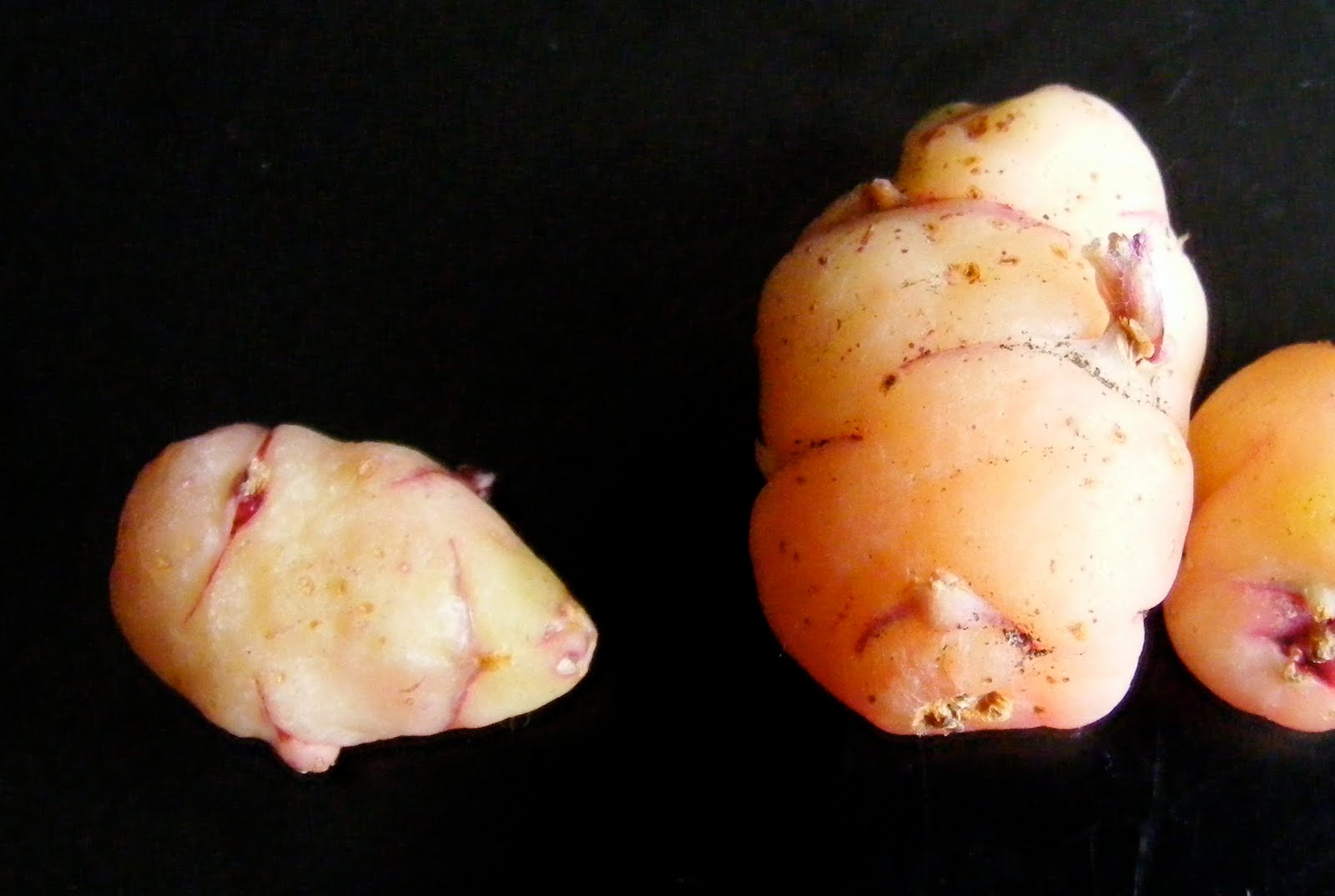
Of note would be 026 which produced this fasciated tuber...
...and 023, very productive, and many of whos tubers are characteristically elongated and possibly fasciated. This seems very interesting, and could be a route to increased tuber size.
014 and 008 yielded beautiful clean tubers...
This last one is not one of Frank's. It's grown from slips taken from the pink striped tuber that I got from Joel Carbonnel. Strangely the tubers are neither striped nor pink, but show varied colouration, and tiny flecks of purple at the ends of some eyes. It seems as if there is some instability going on, so this could be one for development. In any case it's a good cropper.
Meanwhile my main bed of 'eating' varieties was frosted back the other night, so they'll be ready to lift in time for Christmas.
Showing posts with label varieties. Show all posts
Tuesday, 13 December 2011
Monday, 11 April 2011
Oca — Sprouting and Ready to Go
If these tubers could talk, they'd shout "plant us!"
Usually I have them starting in pots in the greenhouse by this time of year, but I've been busy, and as a result they've been sitting in storage, in an orderly but impatient manner in their egg boxes...

That's a lot of varieties to fit in to my available growing space. I had a rough planting plan in my head, and felt it would all be fine at a squeeze, but then last week I received a package from Frank Van Keirsblick containing a further seventeen new varieties, all neatly bagged and labeled, from his breeding programme.
This was good because I now have greatly improved crossing potential with so many varieties increasing the chances of compatible flower forms, but I'm going to have to rethink the grand plan to accommodate all of these extra plants.
With Frank's, plus four each of my existing varieties totaling about 70 plants, there are going to have to be some logistical cut-backs too; greenhouse-space, pots, compost, are all in short supply. I'd like to plant out direct, but the ground is not prepared yet, so I'll try a method less extravagant than individual 4" pots.
I've packed 64 tubers into two root-trainer trays. They should be fine for a couple of weeks, and take up very little space in the mean time.
One set of venetian blinds later, Frank's varieties are labeled up...
... and order is maintained - so far.
Usually I have them starting in pots in the greenhouse by this time of year, but I've been busy, and as a result they've been sitting in storage, in an orderly but impatient manner in their egg boxes...
That's a lot of varieties to fit in to my available growing space. I had a rough planting plan in my head, and felt it would all be fine at a squeeze, but then last week I received a package from Frank Van Keirsblick containing a further seventeen new varieties, all neatly bagged and labeled, from his breeding programme.
With Frank's, plus four each of my existing varieties totaling about 70 plants, there are going to have to be some logistical cut-backs too; greenhouse-space, pots, compost, are all in short supply. I'd like to plant out direct, but the ground is not prepared yet, so I'll try a method less extravagant than individual 4" pots.
I've packed 64 tubers into two root-trainer trays. They should be fine for a couple of weeks, and take up very little space in the mean time.
One set of venetian blinds later, Frank's varieties are labeled up...
... and order is maintained - so far.
Monday, 27 September 2010
Inky Oca Lands in London!
I've just received a sudden and unexpected surge of oca germplasm direct from darkest Peru! Thanks to friend, Joel Carbonnel for giving me the pick from his box of mixed Andean tubers.
Pride of place must go to this almost-black oca.

It seems different to any of the other varieties I have; quite apart from the colour, the bulges below each eye are more defined and scale-like, and its overall proportion is longer. The sprouts showing in the eyes are dark purple, and careful investigation with a scalpel reveals pale purple flesh.
Its rarity (or non-existence?) in these latitudes may be a sign that it will not tuberise well here, but even so, it could still be valuable as a breeding partner for the development of new varieties if it can be persuaded to flower.
The second tuber was nearly ignored, being a variety that I already have, but...
...then I noticed that one end was striped with a contrasting pale pink. If I discard the non-striped end, the remaining eyes should produce all-stripped tubers.
And finally this gold-coloured Mashua. I don't think it is a rare variety, but it's new to me, and next year I'll be trying it alongside the white variety that I have already.
The tubers will be seasonally confused, having just gone through winter in another hemisphere, and they are showing signs of sprouting. I need to get them into cool storage straight away where they can recover from their jet-lag before next spring. I know from experience that they should be tough enough to survive 'til then, as long as they don't get too dried out.
Pride of place must go to this almost-black oca.
It seems different to any of the other varieties I have; quite apart from the colour, the bulges below each eye are more defined and scale-like, and its overall proportion is longer. The sprouts showing in the eyes are dark purple, and careful investigation with a scalpel reveals pale purple flesh.
Its rarity (or non-existence?) in these latitudes may be a sign that it will not tuberise well here, but even so, it could still be valuable as a breeding partner for the development of new varieties if it can be persuaded to flower.
The second tuber was nearly ignored, being a variety that I already have, but...
...then I noticed that one end was striped with a contrasting pale pink. If I discard the non-striped end, the remaining eyes should produce all-stripped tubers.
And finally this gold-coloured Mashua. I don't think it is a rare variety, but it's new to me, and next year I'll be trying it alongside the white variety that I have already.
The tubers will be seasonally confused, having just gone through winter in another hemisphere, and they are showing signs of sprouting. I need to get them into cool storage straight away where they can recover from their jet-lag before next spring. I know from experience that they should be tough enough to survive 'til then, as long as they don't get too dried out.
Monday, 14 June 2010
Early Sprouter, Early Flowerer.
Yesterday, amongst the Oca / Sweetcorn bed, I was surprised to see one of the Oca was flowering already. In my experience this is a couple of months earlier than usual. Consulting my notebook, I see that the plant is one of a selection that I have tentatively labeled 'Real Seeds Red (Early Sprouting)', as it is the second generation of tubers to be earlier to spring in to life than standard Real Seeds Red.
Perhaps there is a connection - the plant is vigorous, and generally keen to get on with life, and will go on to produce early tubers. But I am realistic enough to look for other explanations. The plants suffered some frost damage after they were planted out, and it may have acted as a stimulus to flowering. This would certainly be a beneficial trait at the end of the growing season - a 'set seed before it is too late' gene.
Alternatively, watering with dilute urine stimulates flowering, or then again it's just a freak occurrence.
It gives me a chance to practice identifying Oca stylar morphs. This seems to be mid styled.
Anyway, the act of flowering is forlorn in this case, as there are no suitable pollination partners available yet (EDIT ...or so I thought - see first comment to this post, from Rhizowen). I looked around with frustration and notice Creeping Woodsorrel (Oxalis corniculata), a cousin of Oca, growing as a weed in the next bed. It's flowering. The flower structure looks very similar to Oca's. Hmmm...
... I'm knowledgeable enough to know that it shouldn't work, but ignorant enough not to be sure it's impossible. There's nothing to loose by trying it.
EDIT During the following two weeks, three more of the same variety flowered, but none of the other varieties. Curious.
I was joking previously when I mentioned Watering with dilute urine
On an unrelated topic, since I read up a bit on vegetable breeding, I seem to be noticing mutations all around me now. Anyone for a bearded strawberry?
Labels:
crossing,
frost-damage,
Oca,
Oca flowers,
varieties
Friday, 30 April 2010
Oca Crossing - Giving it a Stab
The threat of frost has finally gone, and space is needed in the greenhouse for expanding tomato plants, so the Oca must go out into the ground.
With multiple varieties at hand this year, there is the obvious opportunity to encourage some crossing with the hope of selecting for reduced day-length sensitivity. It's new ground for me, but armed with a recently purchased copy of Carol Deppe's 'Breed Your Own Vegetable Varieties', and having learned of the picky outbreeding ways of Oca on the Radix website, I feel ready to give it a go.
My limited stock of new varieties needs to be multiplied up for a planned variety trial next year, so this year they can be grown mixed closely together in one bed to maximise the opportunity for natural and assisted cross-fertilisation. Lets just hope there will be some simultaneous multi-variety flowering, and bees that know about Oca stylar morphs! Otherwise it's going to be knee-pads, tweezers and magnifying glass.
(Below) Here they are laid out for planting. I'm using a slightly denser pattern than previously - two staggered rows of Oca down the centre of the bed.

The bed still has to earn its keep, so once the warm weather arrives cordon tomatoes are added either side, and a quick row of plug-grown red lettuce seedlings along each edge makes full use of the space.
I had a bag of builders sand lying around, so I've scattered it on the surface to reflect light up to the toms, which have been suffering in an overcrowded greenhouse for too long. Here's the view on 21/5/10:

There is a very brief flurry of flowers from one variety in early June (see 'Early Sprouter, Early Flowerer'), then nothing until the 19th of September when one of the variety 'White' produces a flower or two. Conditions were obviously then right, because all of the 'White' plants started to bloom wholesale.
Up until very recently it has been generally accepted that a single Oca variety cannot self-pollinate, but leading-edge events seem to undermine this belief.
Taking this in to account, even though I have only one variety in flower at this stage, I think it is worth the effort to bag a few of the flowers just in case I can collect some seed.
Bagging is required because Oca has a very effective seed dispersal strategy - exploding seed pods.
There's been heavy rain and strong winds, so I've tethered the bags to wire pegs to make sure I can retrieve them all.
Despite the change in the weather, there still seem to be plenty of pollinators at work, so no need for manual methods yet. I watched this chap systematically visiting every Oca flower along the bed before he headed off towards some squash flowers.
30/9/10 The really good news is that I can see flowers buds developing on three more varieties : pale pink/purple eyes,
gold/purple eyes, and white/pink eyes.
Another week, and I'll have potential for some crossing action!
Now, if it would just stop raining ...
20/10/10 Drat! Frost kills all plants. No ripe seed obtained.
With multiple varieties at hand this year, there is the obvious opportunity to encourage some crossing with the hope of selecting for reduced day-length sensitivity. It's new ground for me, but armed with a recently purchased copy of Carol Deppe's 'Breed Your Own Vegetable Varieties', and having learned of the picky outbreeding ways of Oca on the Radix website, I feel ready to give it a go.
My limited stock of new varieties needs to be multiplied up for a planned variety trial next year, so this year they can be grown mixed closely together in one bed to maximise the opportunity for natural and assisted cross-fertilisation. Lets just hope there will be some simultaneous multi-variety flowering, and bees that know about Oca stylar morphs! Otherwise it's going to be knee-pads, tweezers and magnifying glass.
(Below) Here they are laid out for planting. I'm using a slightly denser pattern than previously - two staggered rows of Oca down the centre of the bed.
The bed still has to earn its keep, so once the warm weather arrives cordon tomatoes are added either side, and a quick row of plug-grown red lettuce seedlings along each edge makes full use of the space.
I had a bag of builders sand lying around, so I've scattered it on the surface to reflect light up to the toms, which have been suffering in an overcrowded greenhouse for too long. Here's the view on 21/5/10:
There is a very brief flurry of flowers from one variety in early June (see 'Early Sprouter, Early Flowerer'), then nothing until the 19th of September when one of the variety 'White' produces a flower or two. Conditions were obviously then right, because all of the 'White' plants started to bloom wholesale.
Up until very recently it has been generally accepted that a single Oca variety cannot self-pollinate, but leading-edge events seem to undermine this belief.
Taking this in to account, even though I have only one variety in flower at this stage, I think it is worth the effort to bag a few of the flowers just in case I can collect some seed.
Bagging is required because Oca has a very effective seed dispersal strategy - exploding seed pods.
There's been heavy rain and strong winds, so I've tethered the bags to wire pegs to make sure I can retrieve them all.
Despite the change in the weather, there still seem to be plenty of pollinators at work, so no need for manual methods yet. I watched this chap systematically visiting every Oca flower along the bed before he headed off towards some squash flowers.
30/9/10 The really good news is that I can see flowers buds developing on three more varieties : pale pink/purple eyes,
gold/purple eyes, and white/pink eyes.
Another week, and I'll have potential for some crossing action!
Now, if it would just stop raining ...
20/10/10 Drat! Frost kills all plants. No ripe seed obtained.
Tuesday, 30 March 2010
Oca Variety Roundup.
It had to be done! I've assembled a spectrum of Oca varieties from various sources, and am cataloging them here. It's quite odd that there are no accepted named varieties of Oca in Europe or North America, or at least none that I know of. Feel free to correct me on that.
I'm cataloging them simply by background tuber colour, and eye colour. I will add any other characteristics or identifiers once I see the plants growing, along with any observations on their habit or productivity.
Many of the varieties above are courtesy of tris0070 who provides Oca and other unusual tubers via eBay.
I'm cataloging them simply by background tuber colour, and eye colour. I will add any other characteristics or identifiers once I see the plants growing, along with any observations on their habit or productivity.
Pale creme, self-coloured eyes (aka 'White').
Pale creme, pink eyes (possible variation on right, pale creme, purple eyes)
Pale yellow/green, self-coloured eyes. The colour difference between this and 'pale creme' is not very obvious on-screen.
Pale gold, purple eyes.
Pale pink, purple eyes.
Rose, self-coloured eyes.
Pale red, white eyes. Source, a sport of Real Seeds 'Red'
Dark scarlet, self-coloured eyes.
Orange-pink, purple eyes. Offspring of tubers bought in a UK supermarket eight years ago, so almost certainly a New Zealand commercial variety. Thanks to Catstripe for the tubers.
Ruby red, white eyes. Again, from tubers bought in a UK supermarket eight years ago, so almost certainly a New Zealand commercial variety. Again, from Catstripe.
Many of the varieties above are courtesy of tris0070 who provides Oca and other unusual tubers via eBay.
Subscribe to:
Comments (Atom)