Mashua 'Pilifera' has given me a very encouraging crop this year.
... unlike last year when I grew them 'properly' i.e. on their own. They struggled, probably because they were too exposed to strong sun, and weren't watered enough, but I did get some small tubers before the frost finished things.
This year I bi-cropped them with tall peas. 'Relay-cropping' is probably a more accurate term, as the crops overlapped rather than coincided in time.
My logic was to make shared use of the 7ft high pea supports, and for the Mashua to benefit from the shading and summer watering associated with the peas. After the pea crop was harvested, I just left the Mashua to climb through the dying stems for the remainder of the season, until killed by the frost.
This worked so well that I think I feel a few other Mashua-based polyculture schemes coming on...
Meanwhile here are some of the cleaned up tubers...
Notice that one tuber has resprouted — indicative of the recent mild weather, and demonstrating the plant's perennial intentions.
My single specimen of an unknown gold-coloured variety failed to survive the Summer, and has left no tubers. It's a pity, because I grew the two varieties through each other with the specific aim of facilitating cross-fertilisation.
That didn't work, but as at least the Pilifera has set some seed on its own.
Like Oca most Mashua clones are day-length sensitive, so growing from seed is potentially valuable in creating variation that may include earlier tuberisation.
What I would like is to obtain the variety 'Ken Aslet' which flowers and crops earlier, and grow the two together with a view to crossing. Anyone got a couple of surplus KA tubers?
Well, if you don't ask, you don't get!
Showing posts with label bi-cropping. Show all posts
Thursday, 5 January 2012
Monday, 27 June 2011
Main Oca Bed 2011 — If It Ain't Broke...
Last year's growing arrangement of Oca with cordon tomatoes was hard to fault, so I've just tweaked it slightly to optimise spacing and make it easier to manage this time round. Oh, and it's beetroot instead of lettuce for the quick-growing edge crop.
Here is Oca 'Dark pink', not yet at the sprawling stage, growing strongly between tomato 'OSU Blue', despite being subject to a medley of drought, high wind, downpours and hailstorms since planting out.
Observant readers might notice that there is incomplete fruit set on the tomato. I'm pretty sure this is due to the very dry conditions earlier in the season rather than any affect from the oca foliage covering the lower trusses.
The bed's timetable in detail:-
13th April. Cleared the preceding green manure crop (grazing rye). Tops hoed off with an azada, and removed, roots left in situ. Not dug.
14th April. Beetroot (plugs, sown 15th March) were planted out.
The tiny plants are just visible in rows 9" from the bed edge (centre foreground bed)...
I could have planted out the Oca at the same time, but last year they got a bit of frost damage around now, so no need to rush things as they are happily growing away in Root trainers at this point.
9th May. Oca and tomatoes finally get planted out. The Root trainer method seems like a success, and I'm sure this will give them a better start than using pots.
Tomatoes planted, Oca laid ready to plant, beetroot doing well...
That's Cheltenham Greentop on the left, and 'White' on the right.
The tomato supports are on 16" spacing, with 24" between the staggered rows. Incidentally this assumes using the UK conventional cordon growing method (side-shooting, and deleafing lower part of stem). If you use the American cage method I'd go for much wider spacing.
5th June. Full ground cover from the Oca between the tomatoes, and beet down the edges (beetroot now being harvested).
10th June. Tomatoes are starting to crop. (Below) This is Katja, a Siberian variety, surprisingly the first to ripen. Thanks to Søren of Toad's Garden for the seed.
31st June. Oca stems over-reach themselves and collapse down at this time of year. This, along with deleafing the lower part of the tomato cordons improves ventilation and light access. The dappled shade from the tomatoes is enjoyed by the Oca, reducing stress in hot weather.
Here is Oca 'Dark pink', not yet at the sprawling stage, growing strongly between tomato 'OSU Blue', despite being subject to a medley of drought, high wind, downpours and hailstorms since planting out.
| 26/6/11 |
The bed's timetable in detail:-
13th April. Cleared the preceding green manure crop (grazing rye). Tops hoed off with an azada, and removed, roots left in situ. Not dug.
14th April. Beetroot (plugs, sown 15th March) were planted out.
The tiny plants are just visible in rows 9" from the bed edge (centre foreground bed)...
I could have planted out the Oca at the same time, but last year they got a bit of frost damage around now, so no need to rush things as they are happily growing away in Root trainers at this point.
9th May. Oca and tomatoes finally get planted out. The Root trainer method seems like a success, and I'm sure this will give them a better start than using pots.
Tomatoes planted, Oca laid ready to plant, beetroot doing well...
That's Cheltenham Greentop on the left, and 'White' on the right.
The tomato supports are on 16" spacing, with 24" between the staggered rows. Incidentally this assumes using the UK conventional cordon growing method (side-shooting, and deleafing lower part of stem). If you use the American cage method I'd go for much wider spacing.
5th June. Full ground cover from the Oca between the tomatoes, and beet down the edges (beetroot now being harvested).
10th June. Tomatoes are starting to crop. (Below) This is Katja, a Siberian variety, surprisingly the first to ripen. Thanks to Søren of Toad's Garden for the seed.
31st June. Oca stems over-reach themselves and collapse down at this time of year. This, along with deleafing the lower part of the tomato cordons improves ventilation and light access. The dappled shade from the tomatoes is enjoyed by the Oca, reducing stress in hot weather.
8th August. Tomatoes in full production.
4th December, tomatoes removed after the first light frost.
Tubers are swelling!
Harvest still to come!
|
Labels:
bi-cropping,
companion planting,
Oca,
polyculture,
tomatoes
Wednesday, 11 May 2011
'Minor' Root Crops as Ground-Cover in Polycultures
Oca can provide extremely effective ground-cover within a vegetable polyculture, as demonstrated with tomatoes, or sweetcorn. But how about using other minor root crops in the same role?
Ulluco for example...
... and Chinese artichoke (below) both give cover earlier in the growing season, lasting through to the first frost. And being very definitely 'minor' in productivity, I can't justify either of them as a monocrop; my basic criterion is that bed-space must produce a decent kitchenable yield, preferably with the minimum of labour.
But even if they don't produce much crop, at least they can reduce my weeding and watering by acting as a living mulch around other more productive crops .
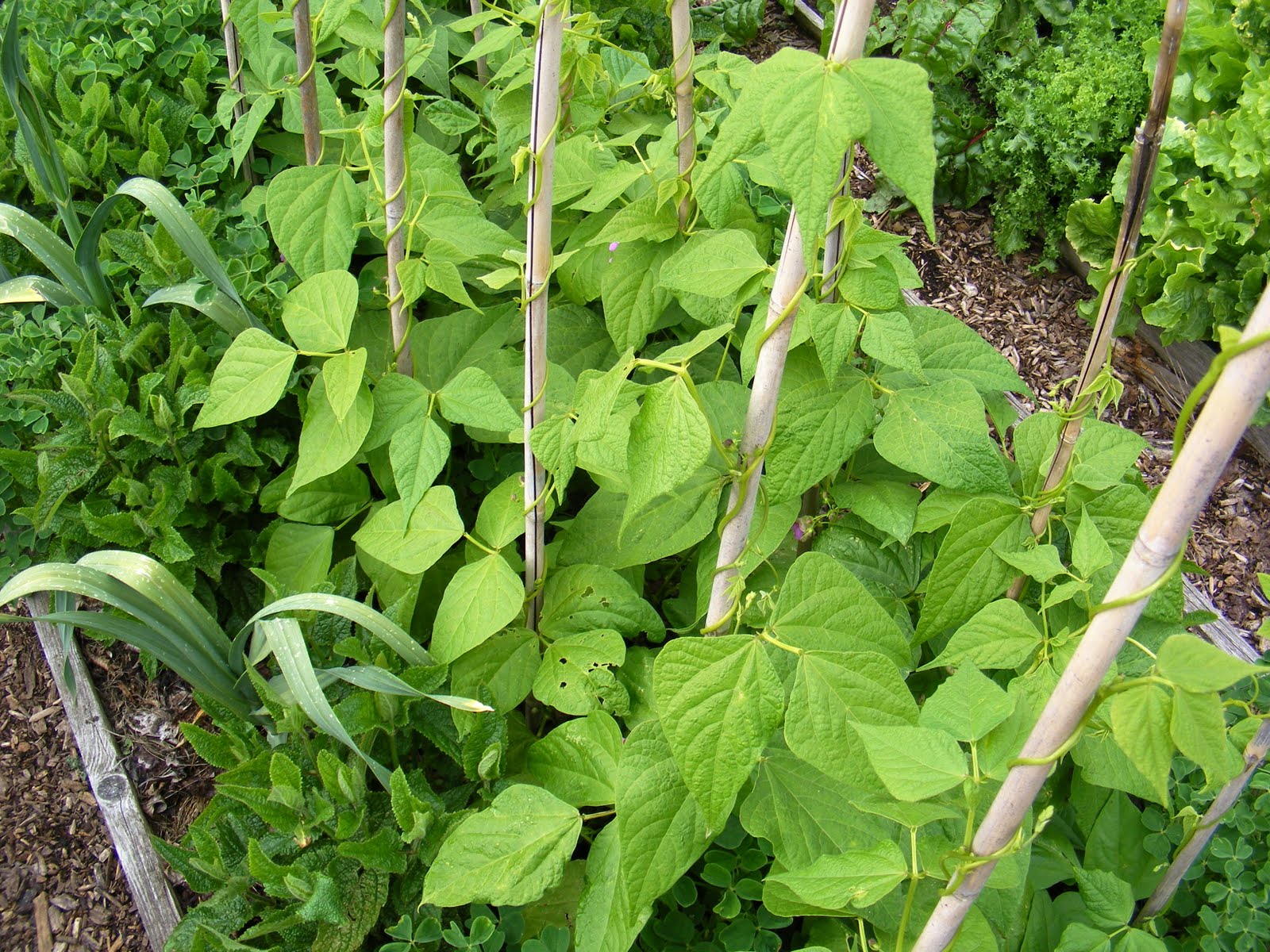
I'm going to give them both a try growing with climbing French beans, plus garlic and elephant garlic.
Last autumn the bean-bed-to-be was cleared too late to establish an overwintering green-manure crop, so without digging, I planted it with garlic and elephant garlic, then added autumn leaves, retained with steel mesh. Here's the scene in late winter...
In early April the mesh is removed, and the ulluco and Chi-chokes (previously started in pots in an unheated greenhouse) are added between the garlic. Plastic sheet is placed down the centre of the bed to warm the soil for the beans.
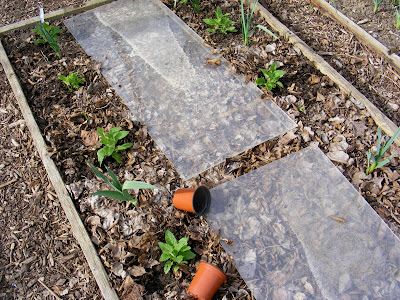
Initially, there's a lot of slug-damage to the ulluco, especially those with green stems. The red colouration of some varieties seems to offer protection against pest damage.
Removing the plastic sheet, allowing access to foraging birds, seems to improve matters.
Bellow, supports added in readiness for the French beans. The weather is hot and dry, so the mulch is topped up with a layer of grass cuttings.
5th of May, (below) the French beans, started previously indoors in root-trainers, are planted out.
Just after the photo was taken I pinched out the tips of the Chinese artichokes to encourage more side growth. There's no sign of any weeds getting through the autumn leaves yet (apart from the odd oca volunteer - which will be tolerated for now).
All done! If the ground-cover crops expand to give full cover before the leaf mulch breaks down, then there should be no more work involved apart from harvesting. My one concern is that there may be excessive competition for moisture between the crops if there is a dry summer, but we shall see.
Update 9th June. First produce from the system is garlic...
... no complaints there.
Meanwhile, the beans are twining, and the ground cover is closing up well...
The Chi-chokes have just about reached full cover, but the Ulluco are slightly slower.
Update 30th June. Next — the elephant garlic has died back, so harvest time:
Some have only formed rounds rather than cloves, probably as they were slightly late getting planted. Lifting them caused a bit of disturbance to the Chi-chokes' roots, but hopefully no serious harm done.
Update 3rd August. The beans have been cropping well for about four weeks. The ground cover is complete, and virtually no weeds have made it through.
Update 22nd November. The beans and their supports have been removed. The first picking of tubers, a square foot of the bed, delivers enough Chinese Artichokes for a meal...
I feel a stir fry coming on.
Update 16th January. I'm continuing to lift tubers as they are needed in the kitchen. As you can see there are plenty of volunteer Oca to be had amongst the Chinese artichokes...
The Ulluco have now been killed by frost, so I'm also lifting them now. They've done better than last year, but that's not saying much.
.
Ulluco for example...
Sprouting Ulluco tubers lifted from storage in sand, 15th March.
|
... and Chinese artichoke (below) both give cover earlier in the growing season, lasting through to the first frost. And being very definitely 'minor' in productivity, I can't justify either of them as a monocrop; my basic criterion is that bed-space must produce a decent kitchenable yield, preferably with the minimum of labour.
| Chinese artichoke tubers |
But even if they don't produce much crop, at least they can reduce my weeding and watering by acting as a living mulch around other more productive crops .
I'm going to give them both a try growing with climbing French beans, plus garlic and elephant garlic.
Last autumn the bean-bed-to-be was cleared too late to establish an overwintering green-manure crop, so without digging, I planted it with garlic and elephant garlic, then added autumn leaves, retained with steel mesh. Here's the scene in late winter...
In early April the mesh is removed, and the ulluco and Chi-chokes (previously started in pots in an unheated greenhouse) are added between the garlic. Plastic sheet is placed down the centre of the bed to warm the soil for the beans.
| Pot-grown Chinese artichokes planted out, 3rd April |
| Slug-damaged ulluco, 15th April |
Bellow, supports added in readiness for the French beans. The weather is hot and dry, so the mulch is topped up with a layer of grass cuttings.
5th of May, (below) the French beans, started previously indoors in root-trainers, are planted out.
French beans added, 5th May
|
All done! If the ground-cover crops expand to give full cover before the leaf mulch breaks down, then there should be no more work involved apart from harvesting. My one concern is that there may be excessive competition for moisture between the crops if there is a dry summer, but we shall see.
Update 9th June. First produce from the system is garlic...
... no complaints there.
Meanwhile, the beans are twining, and the ground cover is closing up well...
The Chi-chokes have just about reached full cover, but the Ulluco are slightly slower.
Update 30th June. Next — the elephant garlic has died back, so harvest time:
Some have only formed rounds rather than cloves, probably as they were slightly late getting planted. Lifting them caused a bit of disturbance to the Chi-chokes' roots, but hopefully no serious harm done.
Update 3rd August. The beans have been cropping well for about four weeks. The ground cover is complete, and virtually no weeds have made it through.
Update 22nd November. The beans and their supports have been removed. The first picking of tubers, a square foot of the bed, delivers enough Chinese Artichokes for a meal...
I feel a stir fry coming on.
Update 16th January. I'm continuing to lift tubers as they are needed in the kitchen. As you can see there are plenty of volunteer Oca to be had amongst the Chinese artichokes...
The Ulluco have now been killed by frost, so I'm also lifting them now. They've done better than last year, but that's not saying much.
.
Labels:
bi-cropping,
polyculture,
Ulluco
Thursday, 18 November 2010
Oca as Soil Fungicide?
I've previously proposed that Oca makes a good bicrop partner for outdoor cordon-grown tomatoes. This has been based on... ...er, the fact that it seems to work well for me, certainly in terms of physical compatibility - space, light and soil utilisation.
Cue photographic propaganda:-
Thinking more, this also supports my normal practice of leaving oca crop debris to cover the soil after harvest. Fusarium spores can survive in soil over winter, ready to infect any suitable host crops the following summer, but decaying Oca foliage may be releasing natural fungicide, to be rinsed into the soil by winter rain.
Cue photographic propaganda:-
Now, I must say that when it comes to plant companion effects I am, if not actually sceptical, then at least untroubled by high expectations. Some traditional companion effects do not stand up to objective tests, and when they do, it is such a multi-factorial situation that it's difficult to say if the results will successfully translate to other growing conditions.
However going back to Oca and tomatoes, I recently found this paper which shows that water-soluble extract from Oxalis articulata foliage can suppress the soil-borne fungus Fusarium oxysporum, or as it is better known, Fusarium wilt, a particularly destructive and persistent disease of many crops, including tomatoes.
We only have to make a small speculative step to assume that other Oxalis species (including Oca) will contain the same natural fungicide, and by planting them with tomatoes there may be some protective effect during the growing season.
Thinking more, this also supports my normal practice of leaving oca crop debris to cover the soil after harvest. Fusarium spores can survive in soil over winter, ready to infect any suitable host crops the following summer, but decaying Oca foliage may be releasing natural fungicide, to be rinsed into the soil by winter rain.
My outdoor tomatoes die from various things, usually late blight, but one year some, dutifully interplanted with French marigolds, died of fusarium wilt. Now all I'm saying is, perhaps if they had been interplanted with Oca instead...
UPDATE 23/11/10
Lab tests reported here show that ocatin (a protein in oca tubers) suppresses fusarium oxysporum, as well as Phytophthora cinnamomi ('dieback' or root rot), and Rhizoctonia solani ('damping off' and brassica wire stem).
Of course, the fact that the tubers can protect themselves from some fungal problems is a separate issue from foliage anti-fungal properties, but interesting nonetheless.
UPDATE 23/11/10
Lab tests reported here show that ocatin (a protein in oca tubers) suppresses fusarium oxysporum, as well as Phytophthora cinnamomi ('dieback' or root rot), and Rhizoctonia solani ('damping off' and brassica wire stem).
Of course, the fact that the tubers can protect themselves from some fungal problems is a separate issue from foliage anti-fungal properties, but interesting nonetheless.
Labels:
bi-cropping,
companion planting,
disease,
Oca
Tuesday, 8 June 2010
Oca / Sweetcorn Bicrop
Various sources state that this is a traditional Andean cultural method, but I cannot find any description of the specific planting patterns used. They may well have used alternate widely-spaced rows of earthed-up Oca with later-planted corn. But I think corn pollination might suffer from the wide spacing, and the unnecessary soil disturbance and labour does not appeal to me.
I want a method that will suit my no-dig 4ft wide beds, and I think block-planted corn with oca near the centre-line of the bed is going to be the most practical approach for me.
Back on the 25th April the preceding crop of grazing rye was hoed off and removed (for strawing strawberries). Small pot-grown Oca were planted out on the same day.
By the 17th May (below) the Oca are established, but looking very lonely. I never like to see bare soil at the best of times, but continuing cool weather has meant the delayed planting of corn, and the Oca have been on their own for longer than expected. I should have left some of the grazing rye crop-debris on the surface to shade my precious humus and reduce surface evaporation.
Spacing for the corn is the tricky bit. I have a theory that if I can get the corn to support the Oca in an upright position, reducing stem contact with the ground, and thus reducing stem tuber formation, the plants will be forced to concentrate all of their energy into bigger tubers around the roots (see Tubers- big and few, or small and many), and Oca - Be Erect not Supine!). The corn will have to be reasonably close-planted to do this, but must be far enough apart to admit light to the Oca - a fine balance.
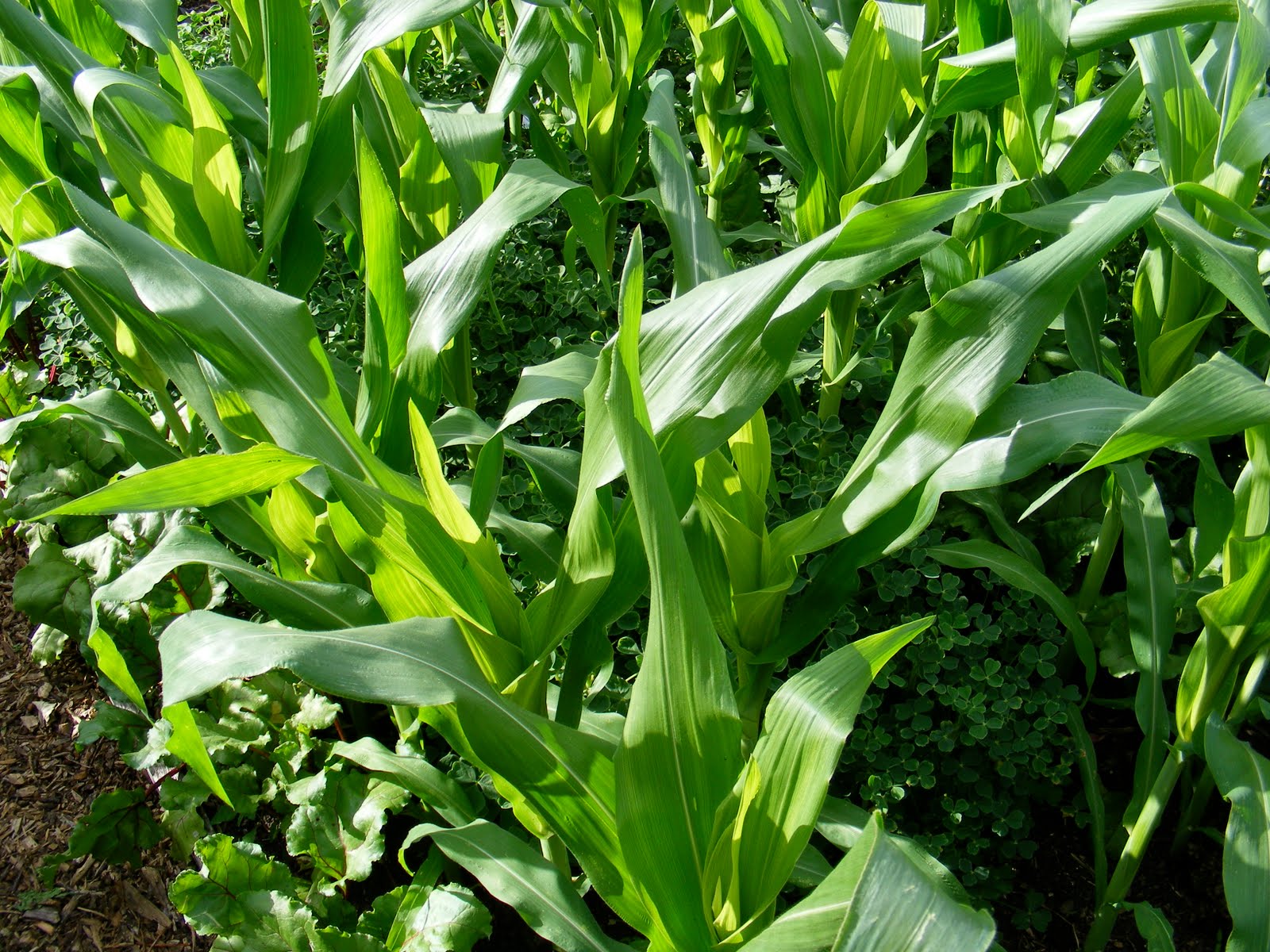
6th of June, the sweetcorn are ready to go...
14th September. The corn has all been harvested, and the plants cut back to admit more light to the Oca during the shortening days.
Update, 2010 Oca harvest here.
I want a method that will suit my no-dig 4ft wide beds, and I think block-planted corn with oca near the centre-line of the bed is going to be the most practical approach for me.
Back on the 25th April the preceding crop of grazing rye was hoed off and removed (for strawing strawberries). Small pot-grown Oca were planted out on the same day.
By the 17th May (below) the Oca are established, but looking very lonely. I never like to see bare soil at the best of times, but continuing cool weather has meant the delayed planting of corn, and the Oca have been on their own for longer than expected. I should have left some of the grazing rye crop-debris on the surface to shade my precious humus and reduce surface evaporation.
Spacing for the corn is the tricky bit. I have a theory that if I can get the corn to support the Oca in an upright position, reducing stem contact with the ground, and thus reducing stem tuber formation, the plants will be forced to concentrate all of their energy into bigger tubers around the roots (see Tubers- big and few, or small and many), and Oca - Be Erect not Supine!). The corn will have to be reasonably close-planted to do this, but must be far enough apart to admit light to the Oca - a fine balance.
6th of June, the sweetcorn are ready to go...
...and are spaced on a grid of about 1ft across the bed and slightly more along the bed. The Oca sit on the same grid so that each is surrounded by four corn. Just visible are beetroot plugs added along the edges of the bed to complete a three-way polyculture, and utilise the extra light available at the sides.
Just one week later (13th June), all three crops are putting on amazingly fast growth. Notice the unusually early Oca flower.
By the 20th of June, just 14 days after planting the corn, the canopy is about to close. So far, the spacing seems to be working just right, and the weeds won't get a look in.
4th July (4 weeks after planting corn) Stand well back everyone!
Keeping a log with photos and dates really highlights how quickly crops grow in midsummer. The Cylindra beetroot are already of a useable size, the corn is waist high, and the Oca foliage is relentlessly advancing towards the edges of the bed.
We've had consistently hot sunny conditions for the last few weeks, and I think the Oca is probably benefiting from the partial shading of the corn.
23rd July. The corn is above head height and showing signs of flowering. Some beetroot have already been harvested, and the Oca is giving full ground cover to the bed.
Weed suppression is absolute.
With the continuing drought, I've been forced to water a few times, and strong winds flattened some of the corn, so they have been staked, but otherwise the bed has looked after itself just fine.
20th August. The corn is cropping. It's averaging two good-sized cobs per plant, so six per linear foot of bed. The beetroot have all been eaten.
4th July (4 weeks after planting corn) Stand well back everyone!
Keeping a log with photos and dates really highlights how quickly crops grow in midsummer. The Cylindra beetroot are already of a useable size, the corn is waist high, and the Oca foliage is relentlessly advancing towards the edges of the bed.
We've had consistently hot sunny conditions for the last few weeks, and I think the Oca is probably benefiting from the partial shading of the corn.
23rd July. The corn is above head height and showing signs of flowering. Some beetroot have already been harvested, and the Oca is giving full ground cover to the bed.
With the continuing drought, I've been forced to water a few times, and strong winds flattened some of the corn, so they have been staked, but otherwise the bed has looked after itself just fine.
20th August. The corn is cropping. It's averaging two good-sized cobs per plant, so six per linear foot of bed. The beetroot have all been eaten.
14th September. The corn has all been harvested, and the plants cut back to admit more light to the Oca during the shortening days.
Update, 2010 Oca harvest here.
Labels:
bi-cropping,
Oca,
polyculture,
Sweetcorn,
trials
Sunday, 10 January 2010
Underground Oca
Frozen soil for the last week has put a halt to lifting tubers, but the last plant I lifted from semi-frozen ground came up so cleanly that the root system was almost intact. This gave a really good view of the root extension and structure.
Notice the original planting tuber, which is still firm and unrotted. I've always thrown these aside (they do not look appetizing) as I would when lifting potatoes, but I'm curious to see if they resprout in Spring, and perhaps take advantage of that existing root system to get a flying start. Looks like something else for me to try this coming season. If anyone out there has tried it, I'd love to know. (update 1/3/10, The original tubers, which I temporarily heeled in with a view to replanting, have in fact now rotted. Some sources state that oca is a perenial, others an annual. My observations would sugest that Oca is not a true perennial, but a plant-replant annual. End update)
When thinking about intercropping, it's simple enough to see if crops are competing above ground, but this got me searching out my well thumbed copy of Robert Kouriks classic read Designing & Maintaining Your Edible Landscape Naturally
which contains some eye-opening scale drawings of various vegetable root zones in the section 'Intercropping Below Ground - The Shape of Roots', which are helpful when visualising the amount of competition between plant root systems. From observation of the plants I've lifted, Oca roots seem to have a similar range to tomatoes - 3 feet radius by 4 feet deep, but with most of the fibrous rootball close to the planting tuber. The fleshy roots, one of which grows from each eye, extend further and send out a more sparse network of fine root hairs which are difficult to follow in the soil, so it's hard to say exactly how far they spread.
But most importantly - those fleshy root stems are STILL alive despite the devastation to the plant above ground caused by days of continuous sub-zero temperatures. My hunch is that tubers continue to expand even this late, by drawing sap from these root stems.
The experiment here will hopefully confirm this.
Labels:
bi-cropping,
Oca,
roots
Wednesday, 2 December 2009
Oh-oh! Oca allelopathy!
Allelopathy is the ability of a plant to chemically suppress the growth of another.
I've just discovered the excellent Radix blog, which focuses on unusual root crops, and it strongly suggest that dried Oca foliage inhibits germination (of lettuce seed in the experiment).
This obviously is important when mixing and overlapping crops.
But it may not be all bad news. Managed carefully, decaying Oca foliage debris could be beneficial in ensuring a weed-free bed for any following crop, as is the case with several traditional green-manure crops. The real problem would be if the plants roots exuded suppressive chemicals while growing. This would make it highly unsuitable for bi-cropping. So far I have seen no evidence of this, but I will be watching out for it.
What I need to do is an experiment to test for this next growing season. Hmmm.
UPDATE: I have found evidence (here) that Oca roots produce an exudate which suppresses growth in competing plants. However, the chemicals are also beneficial - insecticidal, and pathogenicidal. At least some of the chemicals require UV light to be activated, (so effectiveness is restricted to the surface and first few mm of soil?).
UV light levels reaching the root exudates must be very low once the foliage has formed a canopy.
All interesting to know, but as is sometimes the case, science does not give a clear answer. Will Oca poison or protect its bicrop partner, or something between the two?
Well, it obviously does not seriously harm most crops, from the evidence of my own eyes, and the experience of generations of Andean Indians, who's traditional methods of cultivation include bi-cropping with maize, and mixed planting with other tuber crops.
It seems to still come down to 'suck it and see'.
UPDATE: Details and results of the allelopathy trial here.
Labels:
allelopathy,
bi-cropping,
Oca
Sunday, 29 November 2009
2009 Growing Season - Oca with tomatoes
After some consideration I decided to bi-crop with tomatoes as the primary crop.
So ... Action-points for this season:
- Use a more formal multi-crop structure.
- Allow more space for the ultimate size of the foliage.
- Hold out for as late a harvest date as possible.
- Keep better records of dates, spacing etc.
Early March. As previously, I chitted tubers indoors.
Although the tubers saved from the previous season are technically genetic clones, I noticed one tuber sprouted much earlier than the others. Another was a much darker colour. Some mutation does occur, so I have labelled them and will see if the characteristics are passed on.
25th March, planted in pots in an unheated greenhouse.
28th April. Planting out. The plants will be placed in a single row down the centre of a 4ft wide bed (hopefuly giving enough space for the Autumn spread) alternating with the primary crop of cordon grown tomatoes. Spacing is about 20 inches between each tomato, with an Oca between each. Space on either side will be used for spring-sown, fast-maturing crops, which will be harvested before the space is taken by the Oca.
The bed has had an early (sown in February under plastic) green manure crop of mustard. Without disturbing this, 7ft canes are placed ready for the tomatoes, and ...
...the Oca are transplanted in small clearings giving them some protection from any cold wind.
By 9th June, the mustard is long gone and the interplanted tomatoes are knee-high. Direct-sown salad crops are up (here, landcress and spring onions, not visible are module-sown beetroot and lettuce) The tomatoes have received a layer of mulch to encourage stem-rooting and the Oca is still well-behaved.
By 1st August the fast-growing side crops are mostly harvested, just in time for the Oca to spread dramatically.17th August. Tomato cropping is in full flow. The single row of oca is providing complete ground cover across the 4ft bed. The tomatoes have been stripped of leaves over their lower third to aid ripening and ventilation. This also lets in more light to the oca.
1st of November. Blight and cold weather have just about finished off the tomatoes. The Oca is thriving in the cool temperatures and increased moisture levels.
.... and show the first signs of tuber formation. Stems in contact with the ground produce thick fleshy roots which form a tuber at the end.
(6th December) A light frost has damaged the outermost foliage. This seems to have stimulated tuber formation. There are huge numbers of tubers forming where the stems are touching the soil.
(20th December) Two weeks later there have been several proper frosty nights. The crucial period for tuber growth is now!
The plant guild offers up an unexpected bonus crop; the Spring-sown land cress has survived the hot Summer under the Oca, and is now making a come-back through the collapsed stems.
31st December. The foliage is well and truly dead. Surely time to harvest!
For harvest results go here
Labels:
bi-cropping,
Oca,
polyculture,
tomatoes,
trials
Subscribe to:
Comments (Atom)