Showing posts with label polyculture. Show all posts

Thursday, 12 December 2013

Extending the Oca Growing Season through Frost Protection

The death of foliage from frost signals the end of the oca season, but at this time of year when tuberisation is in full swing, any slight extension of the growing season will have the maximum effect on crop yield. I stress that again; even one extra week without killing frost could easily  have more effect on yield than any other factor over the whole growing period.
But it's important to point out that oca can survive light frosts, and there may be some variation among varieties in this ability.
Furthermore, it has been speculated that cold weather or slight frost damage may contribute to initiate or accelerate tuber bulking.

Most frosts in autumn are radiation frosts, occurring on clear windless nights, often just for an hour or so at dawn. These are capable of being combatted more easily than advection frosts, which are associated with a more fundamental and long lasting atmospheric low temperatures.

So until new varieties with day-length-neutral tendencies come along, here are 20 ways to minimise the risk of crop loss from frost:

Topographic placement and aspect. Avoiding frost pockets, and facilitating cold air drainage away from crops is a well understood method. Less commonly understood, is the effect of the upslope area; depending on the soil surface, this can chill or warm the air flowing down over the cropping area. Bare soil, or hard surfaces will produce warmer conditions than continuous ground vegetation or thick mulch.
South-facing slopes will receive and store higher levels of the sun's energy than north facing, and so have more to radiate during the night.

Mini-scale cold air drainage. Raised beds can protect from slight frosts by allowing cold air to drain away to the lower path areas. Paths should be unobstructed, and run downslope to drain air efficiently, though this may conflict with soil erosion considerations. Beds with high wooden edging are as likely to trap frost as they are to shed it. Growing on supports such as netting, pea sticks, or a tall companion crop may also have some beneficial effect in keeping top growth above the coldest air.
Come the first frost, this oca crop should benefit from its bed being raised by a foot or so above the paths, and from its companion crop of sweetcorn, who's dried stems will be left in situ after harvest to trap radiated warmth. The mulch of rotten hay will prevent the soil from keeping the air warm, so should be removed before frosts are due in autumn.
Downslope air flow. Any areas or rows of harvested tall crops should be cleared away before frosts if they are located where they may obstruct or slow the cold air flow away from the crop bed in question.

Cold Hardening. Exposure to cold conditions is considered by some to increase the crop's frost tolerance, but this effect is apparently nullified by any following period of warm weather, so refrain from adding polythene crop protection if the weather is merely cool. Interestingly, cold hardening of many plant species is associated with the translocation of carbohydrates to the roots, so this may be significant in accelerating tuber bulking.

Nutritional Hardening. There is some research showing that plant nutrition may influence frost resistance. Understanding seems poor, but it's probably beneficial to avoid nitrogen feeds in the period coming up to the frost season.

Sacrificial companion crops. A taller crop grown with the oca can help to hold warmer air close to the ground. Yacon works well, and can usually produce good crops itself before frost arrives, as it is not day-length sensitive. A slight disadvantage is that once frosted, the companion crop looses some of its protective value due to reduced canopy density.
Yacon burned by frost. The Oca underneath is undamaged.

Crop debris from previous companion crop. The dead standing remains of tender tall crops (such as corn, tomatoes or quinoa) grown with the oca during the Summer can provide some slight frost protection if they are left in place.
Cordon tomatoes growing over oca in late Summer. The dead foliage canopy can provide some frost protection later in the year.

Self sacrificial protection. Outermost foliage of oca plants will be killed by the first light frost...
...leaving the rest of the plant unharmed. This is possibly instrumental in boosting the plants' rate of tuberisation. Growing large healthy plants from a full season's growth, or planting at close spacing will result in dense, thick foliage capable of absorbing several frost events before the plant is killed.

Physical covers. Polythene, horticultural fleece, newspaper, netting, straw, or sacking can protect against several degrees of frost. For simple management, they need not be removed between frosts, but simply left in place until harvest. Avoid placing them too early, or the plants' cold-hardening adaption may be compromised.
Scaffold debris netting protecting a bed of oca. After a night of -4°C the plants are limp but not killed. Other root crops in the photo are (from top left clockwise) celeriac, Hamburg parsley, chuffa, skirret.

Casual covering. Crop debris collected from nearby spent crops, such as pea haulms, corn stalks, weeds, etc can simply be thrown over the crop, then left until harvest time. N.B this is not a soil mulch, which would reduce soil radiation; it must be placed over the crop foliage to hold radiated warmth around it.

Water spraying. Popular with commercial fruit growers, this relies on latent heat of fusion released during the freezing of water sprayed over the crop. Automated systems are de rigueur for this method, but for really precious crops, some folk may be willing to get up in the middle of a freezing night with the hose! There is an account of using this method on oca crops here. It's strange and counterintuitive, but having the foliage plated in ice really can stop it freezing.

Air disturbance. Some commercial fruit growers use giant fans, or even low flying helicopters to mix air layers, and so prevent crops freezing. Rather an expensive method!

Added thermal mass. Laying bricks, concrete slabs, containers of water, etc on or near the crop beds will increase thermal capacity.

Soil density. Soil with a high ratio of voids (air pockets) will hold less heat than solid soil, and will give up that heat more slowly due to the insulating effect of air, so avoid cultivating the bed, especially as the frost season approaches, to keep the soil dense, and maximise heat storage capacity.

Soil colour. Dark colours are more efficient absorbers and emitters of radiated heat. Building up soil humus levels to darken it, or dusting the surface with soot are effective and traditional. Small amounts of charcoal might work, but there is  a danger that the effect is counteracted by its insulating properties.

Soil surface area. Soil surface with corrugations or 'lumpiness'  has a greater surface area, so is able to deliver heat faster than a smooth soil surface. Raised beds or ridged rows also score here, having a greater area than flat beds.

Soil surface insulation. Any mulch present will greatly reduce radiated heat from the soil compared to bare soil. Rake back mulches when frost threatens. Peaty soils are also poor heat radiators.

Weed Management. Weeds under the crop are undesirable as they reduce radiation from the soil, however weeds taller than the crop are protective, holding warmth under them.

Soil wetness. Water has a higher heat storage capacity than the mineral content of soil, so wet soil will have more heat to radiate to the air. If soil is dry in early winter (as if!) extra watering will help protect against frost.

Active heating. Some fruit orchards used to be protected by smudge pots, or even heaps of burning tyres, but this has fallen out of fashion/become illegal, to be replaced by large propane or petrol burners. Obviously none of these methods are particularly sustainable, or justifiable in current times. The use of manure-fueled hotbeds may work, but controllability and reliability of effect is poor, and the labour involved huge. If heat has to be added artificially to a crop, in my mind, it's a sign that it's the wrong crop for the location.

Friday, 1 November 2013

Oca/Corn/Huauzontle Polyculture — Still Seeking Low-Work Resilient Growing Systems.

In 2010 I posted here on interplanting Oca and sweetcorn. This year, I'm going a stage further by adding Huauzontle (or 'Aztec Broccoli') to that system. Huauzontle is a Chenopod crop producing greens and edible flower-shoots, historically an encouraged weed or tolerated volunteer in Central American maize fields.
Here are the three constituent crops ready to plant out on the 16th of June, Huauzontle on the left...
The Huauzontle seed came from Real Seeds, and was ridiculously fast to germinate; the seedlings were up in 48 hrs, so in future, I would direct sow with confidence. But this time they were multi-sown in cells a week or so after the corn.
The maize is Painted Mountain obtained in a seed swap parcel a few years back, (thank you Jayb). It gave 100% germination despite its age, in sowing conditions that were not really warm enough by normal standards. It's a many-coloured genetically diverse, heat and cold-resilient variety, bred to thrive in the Rocky Mountains. After last year's weather, I'm seeking resilient varieties! Two trays of commercial sweetcorn sown on the same day all rotted, thanks probably to chilly nights in the greenhouse. Not chilly by Rocky Mountain standards evidently.

The oca are a motly collection of leftovers stunted from being left in small cells too long.

Here's the scheme on planting day. That's a four foot wide bed...
 ...which has just been newly created by double digging, incorporating all available organic matter to full depth. Carrying through the resilience theme to the soil, there are even logs buried under there; anything to build up this silt soil, and give some water holding capacity.
Just four weeks after planting, quite remarkably the huauzontle was already providing greens and seed shoots for steaming, but proving too vigorous for this scheme, or at least is too thickly planted, and is shown here just before receiving a serious cutting back...
A few spare lettuce were squeezed along the edge too, and the paths mulched to limit water loss during the ensuing heatwave.

By the beginning of September the corn is ready to pick...
...and, despite occasional chopping back, the Huauzontle continued to be a bit too resilient. The Oca are definitely suffering from lack of light and water at this stage.

Here is the view of the bed on 31st October...

...The oca are expanding fast, fighting back, and flowering, with every indication of a decent harvest to be had by mid winter. The Huauzontle, disheveled by recent gale-force winds, has turned spectacularly red and carries a massive seed crop, so it seems likely that I, just like Central American peasants, will have it as a tolerated volunteer in seasons to come.
With wider spacing of the Huauzontle, this scheme would approach my ideal; no weeds had a chance, and the bed yielded well, but required almost no work input once created. And like the Forth railway bridge, it has redundancy — bits can fall off it, but it still works.

Monday, 27 June 2011

Main Oca Bed 2011 — If It Ain't Broke...

Last year's growing arrangement of Oca with cordon tomatoes was hard to fault, so I've just tweaked it slightly to optimise spacing and make it easier to manage this time round. Oh, and it's beetroot instead of lettuce for the quick-growing edge crop.

Here is Oca 'Dark pink', not yet at the sprawling stage, growing strongly between tomato 'OSU Blue', despite being subject to a medley of drought, high wind, downpours and hailstorms since planting out.
26/6/11
Observant readers might notice that there is incomplete fruit set on the tomato. I'm pretty sure this is due to the very dry conditions earlier in the season rather than any affect from the oca foliage covering the lower trusses.

The bed's timetable in detail:-

13th April. Cleared the preceding green manure crop (grazing rye). Tops hoed off with an azada, and removed, roots left in situ. Not dug.

14th April. Beetroot (plugs, sown 15th March) were planted out.
The tiny plants are just visible in rows 9" from the bed edge (centre foreground bed)...
I could have planted out the Oca at the same time, but last year they got a bit of frost damage around now, so no need to rush things as they are happily growing away in Root trainers at this point.

9th May. Oca and tomatoes finally get planted out. The Root trainer method seems like a success, and I'm sure this will give them a better start than using pots.
Tomatoes planted, Oca laid ready to plant, beetroot doing well...
That's Cheltenham Greentop on the left, and 'White' on the right.

The tomato supports are on 16" spacing, with 24" between the staggered rows. Incidentally this assumes using the UK conventional cordon growing method (side-shooting, and deleafing lower part of stem). If you use the American cage method I'd go for much wider spacing.

5th June. Full ground cover from the  Oca between the tomatoes, and beet down the edges (beetroot now being harvested).
10th June. Tomatoes are starting to crop. (Below) This is Katja, a Siberian variety, surprisingly the first to ripen. Thanks to Søren of Toad's Garden for the seed.
31st June. Oca stems over-reach themselves and collapse down at this time of year. This, along with deleafing the lower part of the tomato cordons improves ventilation and light access. The dappled shade from the tomatoes is enjoyed by the Oca, reducing stress in hot weather.
8th August. Tomatoes in full production.

1st October. Tomatoes on the wane, Oca ascendance.

4th December, tomatoes removed after the first light frost.
Tubers are swelling!

Harvest still to come!

Thursday, 16 June 2011

Not the Three Sisters...

... not the traditional corn/climbing beans/squash polyculture, but a wilder and woolier version with slightly more obstreperous contenders. The Three Hooligans might be a more accurate name for what I have in mind.
Infant hooligans on planting out day (25th May)
'Hooligan 1' is Yacon,  Fiorella,  a Czech-bred quick maturing variety which I grew last year. I can confirm that it does indeed get a move on, and makes tubers long before standard Yacon. Each plant is liable to reach 8ft high by 9ft wide by the end of the season, and produce 10 to 15 pounds of edible tubers.

'Hooligan 2' is the Hog Peanut or Talet (Amphicarpaea bracteata). I don't have any previous experience of growing this, but it's reputation as a rampant reprobate proceeds it. I'm looking forward to trying the beans which form below ground. Thanks to Rhizowen for the seed, who was also thoughtful enough to provide the required specific inoculant to permit nitrogen fixing on the plant's roots.

'Hooligan 3' is admittedly a corn, as in The Three Sisters system, but this is Hopi Blue — a robust and highly variable variety, displaying diverse foliage colour, number of tillers, and ultimate height. It's usually described as growing to about 2 m but I think that must be in its arid homeland, as I have experience of it growing to more like 3m. Almost certainly there are different strains, which also might explain this difference.

But for a successful polyculture, it's as much about how you plant as what you plant. Here's a view showing the planting layout...

That's a 5 ft wide bed. Hopi Blue are more widely spaced than usual to admit light to the Yacon which are planted on the centre of the bed at 4 ft spacing. Hog peanuts are between the Yacon, and should climb to the light. You'll also notice a couple of rows of onions in there. They were planted back in March and could be a mistake, but they were a bargain and you never know, if they get a move on they could form an extra output.

A couple of weeks later the plants have settled in...
9/6/11
... and are still well-behaved, but for how long?

10/7/11


27/9/11 Corn ripening. Flowers on the yacon are a sure sign that tubers are forming below ground. And...
... the hog peanuts are producing their tiny delicate flowers.


16/10/11. The corn is harvested...
...and the corn plants removed. The yacon are about 8ft high and steadily flowering.
More updates later.

Wednesday, 11 May 2011

'Minor' Root Crops as Ground-Cover in Polycultures

Oca can provide extremely effective ground-cover within a vegetable polyculture, as demonstrated with tomatoes, or sweetcorn. But how about using other minor root crops in the same role?
Ulluco  for example...
Sprouting Ulluco tubers lifted from storage in sand, 15th March.


... and Chinese artichoke (below) both give cover earlier in the growing season, lasting through to the first frost. And being very definitely 'minor' in productivity, I can't justify either of them as a monocrop; my basic criterion is that bed-space must produce a decent kitchenable yield, preferably with the minimum of labour.
Chinese artichoke tubers

But even if they don't produce much crop, at least they can reduce my weeding and watering by acting as a living mulch around other more productive crops .
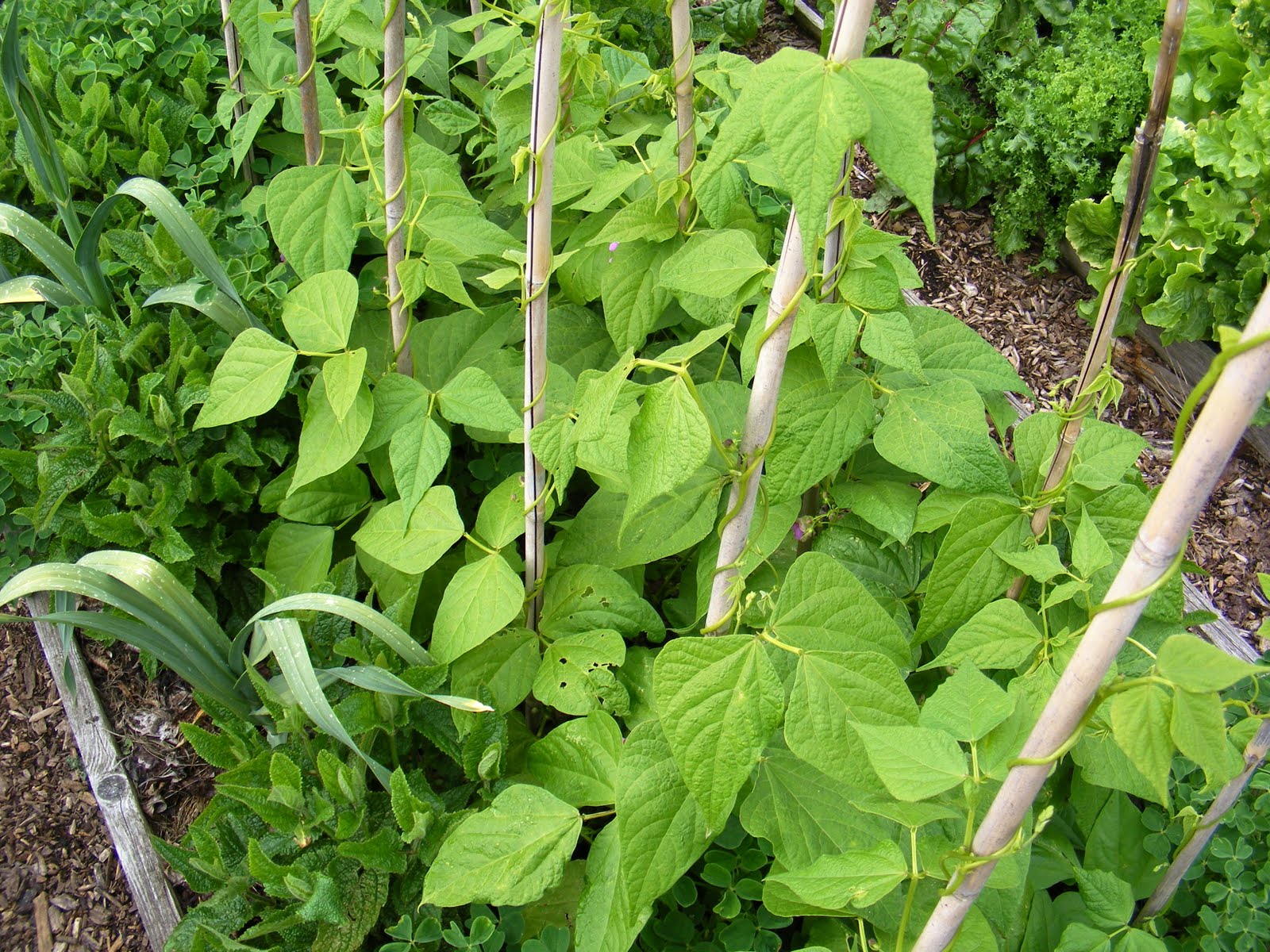
I'm going to give them both a try growing with climbing French beans, plus garlic and elephant garlic.

Last autumn the bean-bed-to-be was cleared too late to establish an overwintering green-manure crop, so without digging, I planted it with garlic and elephant garlic, then added autumn leaves, retained with steel mesh. Here's the scene in late winter...

In early April the mesh is removed, and the ulluco and Chi-chokes (previously started in pots in an unheated greenhouse) are added between the garlic. Plastic sheet is placed down the centre of the bed to warm the soil for the beans.
Pot-grown Chinese artichokes planted out, 3rd April
Initially, there's a lot of slug-damage to the ulluco, especially those with green stems. The red colouration of some varieties seems to offer protection against pest damage.

Slug-damaged ulluco, 15th April
Removing the plastic sheet, allowing access to foraging birds, seems to improve matters.

Bellow, supports added in readiness for the French beans. The weather is hot and dry, so the mulch is topped up with a layer of grass cuttings.
5th of May, (below) the French beans, started previously indoors in root-trainers, are planted out.

French beans added, 5th May
Just after the photo was taken I pinched out the tips of the Chinese artichokes to encourage more side growth. There's no sign of any weeds getting through the autumn leaves yet (apart from the odd oca volunteer - which will be tolerated for now).

All done! If the ground-cover crops expand to give full cover before the leaf mulch breaks down, then there should be no more work involved apart from harvesting. My one concern is that there may be excessive competition for moisture between the crops if there is a dry summer, but we shall see.

Update 9th June. First produce from the system is garlic...
... no complaints there.

Meanwhile, the beans are twining, and the ground cover is closing up well...
The Chi-chokes have just about reached full cover, but the Ulluco are slightly slower.

Update 30th June.  Next — the elephant garlic has died back, so harvest time:
Some have only formed rounds rather than cloves, probably as they were slightly late getting planted. Lifting them caused a bit of disturbance to the Chi-chokes' roots, but hopefully no serious harm done.

Update 3rd August. The beans have been cropping well for about four weeks. The ground cover is complete, and virtually no weeds have made it through.

Update 22nd November. The beans and their supports have been removed. The first picking of tubers, a square foot of the bed, delivers enough Chinese Artichokes for a meal...
 I feel a stir fry coming on.

Update 16th January. I'm continuing to lift tubers as they are needed in the kitchen. As you can see there are plenty of volunteer Oca to be had amongst the Chinese artichokes...

The Ulluco have now been killed by frost, so I'm also lifting them now. They've done better than last year, but that's not saying much.

.


Tuesday, 3 August 2010

The All-Tuber Polyculture Mound

In a quiet corner of 'my other plot' I'm trying another cultural method - a four foot wide mound with three different tuber crops grown closely together. I'm aiming for a low-maintenance easily-harvested dense ruck of tuberous productivity.


Unlike standard polycultures, a clear requirement for an all-tuber polyculture is that the crops involved should mature, and be harvested all at the same time, otherwise lifting one will disturb the roots of those remaining.
Oca, Yacon, and Chinese Artichokes together satisfy this criterion quite well, all normally being harvested after their top growth has been killed by frost.
I started in Spring by clearing the area of the previous Jerusalem artichoke crop (yeah, right!), and digging in a barrow-load of rough compost. This was more to improve water retention and aid soil friability (and hence make harvesting easier) than it was to boost fertility. On top of the mound goes one of my prized new variety purple Yacon, purportedly quick-maturing, but so far untried by me. It is certainly much more vigorous than my other 'standard' Yacon variety. Around this goes Oca, then on the outside edge are the Chinese Artichokes.

This little experiment could easily be scaled up to an informal linear raised bed (or 'lazy bed') if one wanted. It could even work on a commercial scale if suitable harvesting machinery was available.

With all the incorporated compost, thorough deep cultivation, and dense weed-suppressing foliage, this is also ideal as a once-and-for-all soil improvement method before turning ground over to no-dig culture.

Drought is the problem this season. All three crops are showing stress, but it will still be interesting to see what quantity of tubers can be got from this single square metre of ground.

Update 31/8/10
The drought has given way to a couple of weeks of pleasant showery weather. The soil moisture, no doubt helped by all that compost in the mound, has caused the Yacon to double in size. It is now seven foot wide and tall, topped with a lanky bouquet of flowers.
It is even suppressing a couple of late-breaking jerusalem artichoke volunteers, and I now fear for the productivity of the Oca and Chinese artichokes.
I either need a smaller Yacon, or a larger mound!

Update 1/11/10
The first air frost on 21/10 burned back the yacon foliage, but has not completely killed it. Under its protective canopy, the Oca plants have escaped damage, unlike those planted on open beds nearby.
A few days before the frost, I noted the yacon had grown to have a spread of nine feet!

Update 12/12/10
There has been freezing weather for a couple of weeks, and the plants are showing no sign of life. It's a dry day, so a good opportunity to exhume the contents of the mound.


First up is the Yacon. It's a big one! The Health & Safety Executive would have me use a hoist for this job, but after a bit of grunting I manage to get the crown in to a wheelbarrow solely by manual handling methods.
After washing, the useable tubers weigh in at 18 lb (8.2 kg), with another pound or two of small or damaged ones.

Delving around nearer the edges of the mound reveals the 'also rans' – a moderate scattering of mostly undersized Oca and Chinese artichoke tubers.
About 1.5 kg in total – which is as much as I can expect given that the plants have been camped under dense Yacon foliage for most of the growing  season.

CONCLUSIONS
This growing method was successful in terms of yield and low-labour, despite an unusually early frost. Next year it will be even easier; it will only be necessary to plant the Yacon, as there should be ample volunteer Oca and Chinese artichokes.

The imbalance in yield between the three crop species was caused by misjudging the vigour and final size of the particular variety of Yacon chosen. I mistakenly assumed it would be similar to the 'standard' Yacon that I have grown previously, and as a result the Oca and particularly the Chinese artichokes suffered from lack of light. However, a variety being too successful is a good fault, as they say.

It is an interesting and potentialy useful observation that the Oca were protected from the first frost by the Yacon foliage. Yacon, not being reliant on day length, can tuberise early, before sacrificially protecting undergrowing tender crops which have yet to fully tuberise. The partial defoliation lets through more light to ground level, and as long as there is not a second frost, the lower crops benefit.