But there currently seems to be no published information on Oca's allelopathic affects in real-life gardening – how significant they are, and which crops are effected.
Allelopathy can be 'in-crop' (while the allelopathic crop is growing), or 'post crop' (when the breakdown of dead leaves, roots or their associated rhisosphere releases inhibiting chemicals into the soil). Oca may use either or both of these forms of chemical warfare, but this trial focuses on post-crop effect.
Here is the plan: I'll shift my usual vegetable row orientation by ninety degrees, so that crops run across three beds:

Bed 1. (nearest) Previously used for the Oca/cordon tomato trial. This will be examined for the purported allelopathic effect of Oca.
Bed 2. (middle) Previously used for overwintered Hungarian grazing rye (expected allelopathic effect caused by grazing rye).
Bed 3. (far) Previously used for overwintered brassicas (control. No expected allelopathic effect).
The crops will be the usual common garden vegetables – those that I would normally be growing, sown at the time I would normally sow them. Some will be direct-sown, others will be module-grown transplants. In fact I will do exactly what I would normally do, but east-west instead of north-south. Individual crops are detailed at the bottom of the page.
All three beds have a similar cultivation and fertilising history.
Observations.
1. Plants in bed 1 (previously growing oca) were not observed to be generally slower germinating, smaller, or less productive than those on the control bed. Even the potatoes with artificially concentrated amounts of oca crop-debris added to their trench were not inhibited, and in fact were if anything larger and better yielding by the time they were lifted.
2. Plants in bed 2 showed no obvious difference in seed germination despite the well-accepted allelopathic properties of the closely preceding grazing rye.
3. Some crops in bed 3 (control) suffered considerably more from slug damage. Other insect pests (notably flee beetle and pea & bean weevil) seemed to effect all beds equally.
4. Weed and volunteer levels and species were similar on all beds.
Conclusions and speculations.
1. I can't see any general detrimental effect to following crops, and do not intend to allow for it in future planting schemes.
2. Surprisingly, the allelopathic effect of Hungarian grazing rye was not apparent, and I will modify my green manuring practices accordingly.
3. My soil type (heavy clay with high levels of organic matter) may be less affected by allelopathic chemicals in some way. For example, organic matter might act to buffer these chemicals, or the high surface area of clay particles might reduce their mobility in the soil. I'm definitely not an expert on soil chemistry, but different soils would very possibly behave differently.
4. Oca's chemical exudates have been shown elsewhere to be insecticidal, and this could explain the lower levels of damage from soil-dwelling insect pests compared with bed 3. An alternative reason could be that bed 3 was netted to protect the previous brassica crop for most of the Winter. With reduced access to birds, slug population would probably be higher.
5. This year's late Spring gave a longer-than-usual interval between lifting the Oca crop, and sowing the Spring-sown crops. This has given more time for any chemical exudates to break down or be leached from the topsoil.
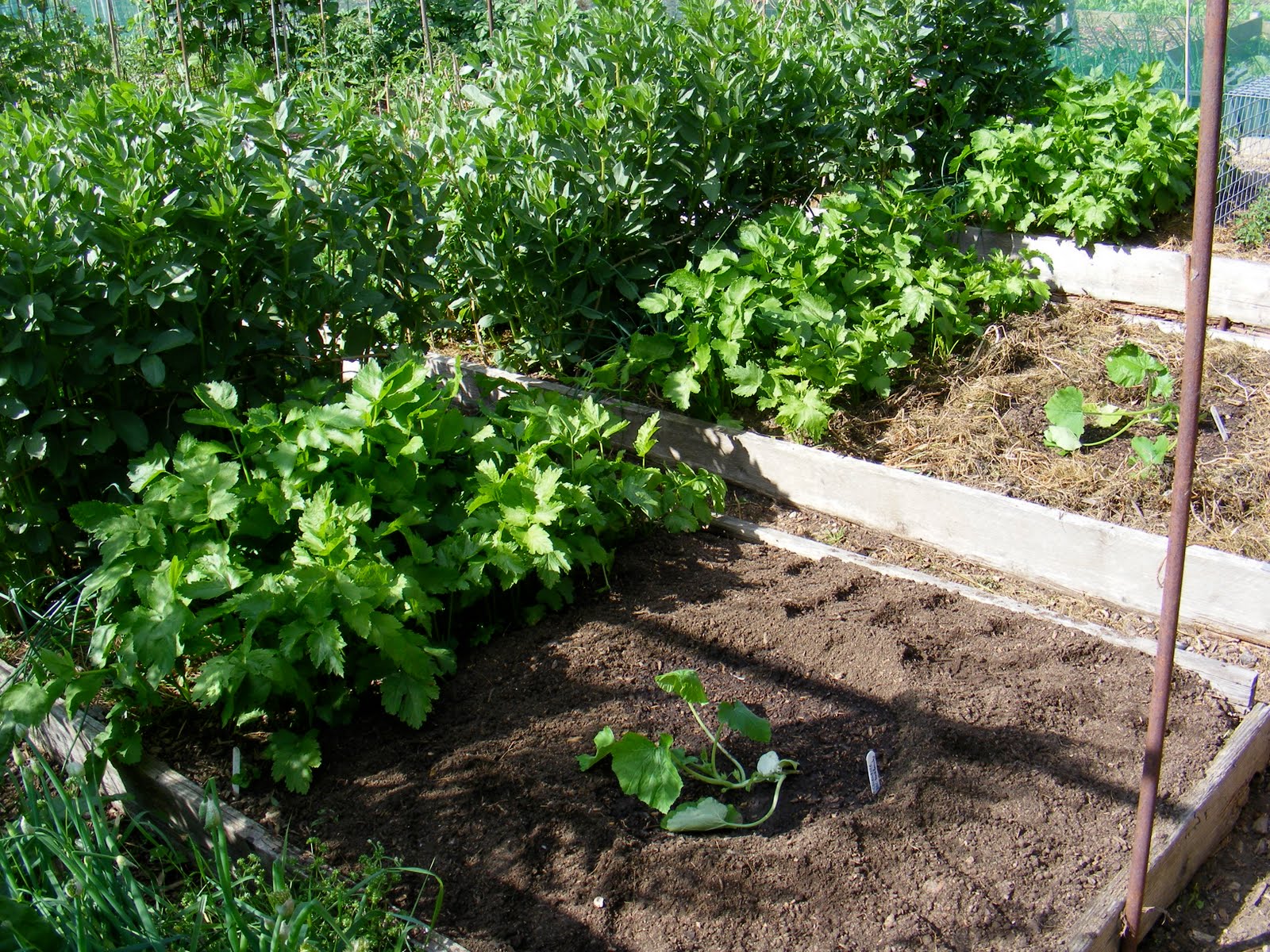
 Above, the view from bed three, 23/5/10
Individual trials are listed below:
Trial 1. Early potato, Swift. Planted 9/3/10. Emerged on all three beds 24/3/10. Harvested 30/5/10, Poor crop due to frost damage. High variability of crop between individual plants, but no obvious pattern between beds.
Trial 1(a). As above, but with Oca crop-residue added to the trench before backfilling (see first photo). First foliage emerging 31/3/10. Foliage noticeably less developed than other rows (see photo below). 25/4/10 Foliage size now caught up with trial 1. 3/5/10 foliage size now overtaken trial 1. Harvested 30/5/10, poor crop due to frost damage.
Trial 2. Agricultural mustard. Sown 14/3/10. Emerged on all three beds 19/3/10. Trial ended on 14/4/10 as the plants are threatening to compete with the Swift potatoes(photo below). Crop will be hoed off and included in the earthing up process. Observation: no noticeable difference in germination, plant health, pest damage or above-ground biomass on the three beds.

Trial 3. Parsnip, Avon Resistor. 14/3/10 sown. 1/4/10 emerging beds 1&2 only. 3/4/10 emerging bed 3.
Trial 4. Parsnip, Tender and True. 14/3/10 sown. 31/3/10 emerging beds 1&2 only. 3/4/10 emerging bed 3.
25/4/10 (seedlings thinned) bed 1 slightly larger plants.
Trial 5. Shallots (sets). 14/3/10 planted. 24/3/10 sprouting on beds 1&2 only. 31/4/10 sprouting on bed 3. 25/4/10 no differences noted between beds.
Trial 6. Broad beans. 23/3/10 transplants (Root trainers) planted out. 25/4/10 no differences noted between beds.
Trial 6(a). Broad beans. 24/3/10 direct sown. 14/4/10 all beds emerged on. 25/4/10 no differences noted between beds.
Trial 7. Peas, Norli. Plug-sown transplants planted out 23/3/10. Slug damage in bed 3 only. Applied slug pellets 31/3/10. Cropping 30/5/10, bed 3 plants weaker/more pest damage.
Trial 7(a). Peas, Norli. Direct sown 28/3/10. All beds emerged on 14/4/10. 25/4/10 slug damage worst on bed 3, pea & bean weevil damage on all beds.
Trial 8. Parsley transplants (pot-grown) 24/3/10.
Trial 9. Leeks, Jaune de Poitou, 24/3/10 small transplants. 25/4/10 no differences noted between beds.
Trial 10. Beetroot, boltardy, plug-sown transplants planted out 28/3/10. Plants destroyed by slugs , bed 3 only 2/4/10. Plants replaced (unfortunately not the same variety) 5/4/10.
Trial 10(a). Beetroot, Cylindra, 28/3/10 direct-sown. 25/4/10 emerged on all beds. patchy germination on bed 1.
Trial 11. Spring Onion, White Lisbon, 4/4/10 direct-sown. 25/4/10 even germination on all beds.
Trial 12. Radish, Rainbow Mixed, 4/4/10 direct-sown. 14/4/10 Even germination on all beds. 3/5/10 severe slug damage on bed 3 only. Cropping 15/5/10
Trial 13. Onion sets, Red Baron, planted out 4/4/10.
Trial 14. Peas, Ezethas Krombek Blau, plug transplants 4/4/10. Flowering 23/5/10. Plants in bed 3 generally taller than the others.
I'm calling a halt to the trial now, because it's becoming inconvenient to treat all three beds identically as gaps form, and space is needed. But if I notice anything else significant, I will add it here.


