Showing posts with label day-length sensitivity. Show all posts

Thursday, 12 December 2013

Extending the Oca Growing Season through Frost Protection

The death of foliage from frost signals the end of the oca season, but at this time of year when tuberisation is in full swing, any slight extension of the growing season will have the maximum effect on crop yield. I stress that again; even one extra week without killing frost could easily  have more effect on yield than any other factor over the whole growing period.
But it's important to point out that oca can survive light frosts, and there may be some variation among varieties in this ability.
Furthermore, it has been speculated that cold weather or slight frost damage may contribute to initiate or accelerate tuber bulking.

Most frosts in autumn are radiation frosts, occurring on clear windless nights, often just for an hour or so at dawn. These are capable of being combatted more easily than advection frosts, which are associated with a more fundamental and long lasting atmospheric low temperatures.

So until new varieties with day-length-neutral tendencies come along, here are 20 ways to minimise the risk of crop loss from frost:

Topographic placement and aspect. Avoiding frost pockets, and facilitating cold air drainage away from crops is a well understood method. Less commonly understood, is the effect of the upslope area; depending on the soil surface, this can chill or warm the air flowing down over the cropping area. Bare soil, or hard surfaces will produce warmer conditions than continuous ground vegetation or thick mulch.
South-facing slopes will receive and store higher levels of the sun's energy than north facing, and so have more to radiate during the night.

Mini-scale cold air drainage. Raised beds can protect from slight frosts by allowing cold air to drain away to the lower path areas. Paths should be unobstructed, and run downslope to drain air efficiently, though this may conflict with soil erosion considerations. Beds with high wooden edging are as likely to trap frost as they are to shed it. Growing on supports such as netting, pea sticks, or a tall companion crop may also have some beneficial effect in keeping top growth above the coldest air.
Come the first frost, this oca crop should benefit from its bed being raised by a foot or so above the paths, and from its companion crop of sweetcorn, who's dried stems will be left in situ after harvest to trap radiated warmth. The mulch of rotten hay will prevent the soil from keeping the air warm, so should be removed before frosts are due in autumn.
Downslope air flow. Any areas or rows of harvested tall crops should be cleared away before frosts if they are located where they may obstruct or slow the cold air flow away from the crop bed in question.

Cold Hardening. Exposure to cold conditions is considered by some to increase the crop's frost tolerance, but this effect is apparently nullified by any following period of warm weather, so refrain from adding polythene crop protection if the weather is merely cool. Interestingly, cold hardening of many plant species is associated with the translocation of carbohydrates to the roots, so this may be significant in accelerating tuber bulking.

Nutritional Hardening. There is some research showing that plant nutrition may influence frost resistance. Understanding seems poor, but it's probably beneficial to avoid nitrogen feeds in the period coming up to the frost season.

Sacrificial companion crops. A taller crop grown with the oca can help to hold warmer air close to the ground. Yacon works well, and can usually produce good crops itself before frost arrives, as it is not day-length sensitive. A slight disadvantage is that once frosted, the companion crop looses some of its protective value due to reduced canopy density.
Yacon burned by frost. The Oca underneath is undamaged.

Crop debris from previous companion crop. The dead standing remains of tender tall crops (such as corn, tomatoes or quinoa) grown with the oca during the Summer can provide some slight frost protection if they are left in place.
Cordon tomatoes growing over oca in late Summer. The dead foliage canopy can provide some frost protection later in the year.

Self sacrificial protection. Outermost foliage of oca plants will be killed by the first light frost...
...leaving the rest of the plant unharmed. This is possibly instrumental in boosting the plants' rate of tuberisation. Growing large healthy plants from a full season's growth, or planting at close spacing will result in dense, thick foliage capable of absorbing several frost events before the plant is killed.

Physical covers. Polythene, horticultural fleece, newspaper, netting, straw, or sacking can protect against several degrees of frost. For simple management, they need not be removed between frosts, but simply left in place until harvest. Avoid placing them too early, or the plants' cold-hardening adaption may be compromised.
Scaffold debris netting protecting a bed of oca. After a night of -4°C the plants are limp but not killed. Other root crops in the photo are (from top left clockwise) celeriac, Hamburg parsley, chuffa, skirret.

Casual covering. Crop debris collected from nearby spent crops, such as pea haulms, corn stalks, weeds, etc can simply be thrown over the crop, then left until harvest time. N.B this is not a soil mulch, which would reduce soil radiation; it must be placed over the crop foliage to hold radiated warmth around it.

Water spraying. Popular with commercial fruit growers, this relies on latent heat of fusion released during the freezing of water sprayed over the crop. Automated systems are de rigueur for this method, but for really precious crops, some folk may be willing to get up in the middle of a freezing night with the hose! There is an account of using this method on oca crops here. It's strange and counterintuitive, but having the foliage plated in ice really can stop it freezing.

Air disturbance. Some commercial fruit growers use giant fans, or even low flying helicopters to mix air layers, and so prevent crops freezing. Rather an expensive method!

Added thermal mass. Laying bricks, concrete slabs, containers of water, etc on or near the crop beds will increase thermal capacity.

Soil density. Soil with a high ratio of voids (air pockets) will hold less heat than solid soil, and will give up that heat more slowly due to the insulating effect of air, so avoid cultivating the bed, especially as the frost season approaches, to keep the soil dense, and maximise heat storage capacity.

Soil colour. Dark colours are more efficient absorbers and emitters of radiated heat. Building up soil humus levels to darken it, or dusting the surface with soot are effective and traditional. Small amounts of charcoal might work, but there is  a danger that the effect is counteracted by its insulating properties.

Soil surface area. Soil surface with corrugations or 'lumpiness'  has a greater surface area, so is able to deliver heat faster than a smooth soil surface. Raised beds or ridged rows also score here, having a greater area than flat beds.

Soil surface insulation. Any mulch present will greatly reduce radiated heat from the soil compared to bare soil. Rake back mulches when frost threatens. Peaty soils are also poor heat radiators.

Weed Management. Weeds under the crop are undesirable as they reduce radiation from the soil, however weeds taller than the crop are protective, holding warmth under them.

Soil wetness. Water has a higher heat storage capacity than the mineral content of soil, so wet soil will have more heat to radiate to the air. If soil is dry in early winter (as if!) extra watering will help protect against frost.

Active heating. Some fruit orchards used to be protected by smudge pots, or even heaps of burning tyres, but this has fallen out of fashion/become illegal, to be replaced by large propane or petrol burners. Obviously none of these methods are particularly sustainable, or justifiable in current times. The use of manure-fueled hotbeds may work, but controllability and reliability of effect is poor, and the labour involved huge. If heat has to be added artificially to a crop, in my mind, it's a sign that it's the wrong crop for the location.

Thursday, 5 January 2012

Mashua

Mashua 'Pilifera' has given me a very encouraging crop this year.


... unlike last year when I grew them 'properly' i.e. on their own. They struggled, probably because they were too exposed to strong sun, and weren't watered enough, but I did get some small tubers before the frost finished things.

This year I bi-cropped them with tall peas. 'Relay-cropping' is probably a more accurate term, as the crops overlapped rather than coincided in time.
My logic was to make shared use of the 7ft high pea supports, and for the Mashua to benefit from the shading and summer watering associated with the peas. After the pea crop was harvested, I just left the Mashua to climb through the dying stems for the remainder of the season, until killed by the frost.

This worked so well that I think I feel a few other Mashua-based polyculture schemes coming on...

Meanwhile here are some of the cleaned up tubers...

Notice that one tuber has resprouted — indicative of the recent mild weather, and demonstrating the plant's perennial intentions.
My single specimen of an unknown gold-coloured variety failed to survive the Summer, and has left no tubers. It's a pity, because I grew the two varieties through each other with the specific aim of facilitating cross-fertilisation.
That didn't work, but as at least the Pilifera has set some seed on its own.
Like Oca most Mashua clones are day-length sensitive, so growing from seed is potentially valuable in creating variation that may include earlier tuberisation.
What  I would like is to obtain the variety 'Ken Aslet' which flowers and crops earlier, and grow the two together with a view to crossing. Anyone got a couple of surplus KA tubers?

Well, if you don't ask, you don't get!

Sunday, 13 November 2011

November is Tuber Time

Most conventional vegetable crops are on the wane by now, but the short days mean only one thing for Oca...
...make tubers, and make 'em fast! These stem-borne Oca tubers are getting noticeably bigger every day, and I've no doubt that those underground are similarly ascendant.  In fact, in places I can see the soil surface starting to heave upwards from the pressure of the swelling crop.

A hands-and-knees survey of the plot discovers plenty more underground action. This is the Ulluco doing its best to tuberise...
...and doing better than last year, when they were already frosted by now.

Chinese artichokes tubers are also bulking up. These are from the plants used as ground cover under climbing beans in the 'root crops as ground cover trial'.

And scraping around the base of a Yacon in the 'Not the Three Sisters' bed reveals sizable storage tubers.
All this bodes well for bumper crops. But of course, a frost could easily put a damper on that.

Unfortunately someone else has noticed all this underground fodder. This is a large excavation on one side of the 'All-Tuber Polyculture Mound'...
Oca, Chi-chokes, and bits of Yacon are scattered around. Rats could be the culprits, although a lot of the uncovered tubers have not been eaten. Then again maybe it's a fox. Anyway, the damage has put a halt to a lot of the plants in the mound.

Grrrrr!

Thursday, 23 September 2010

Oca's day-length thing

Mashua, Yacon and Oca catching low autumnal sun.


It's the autumnal equinox today - the day that nominal night length overtakes day length, and apparently the first day of the year in the agriculture-based French Republican Calendar.  More importantly, it's the time of year when the Andean-tuber grower's attention begins to stray underground.

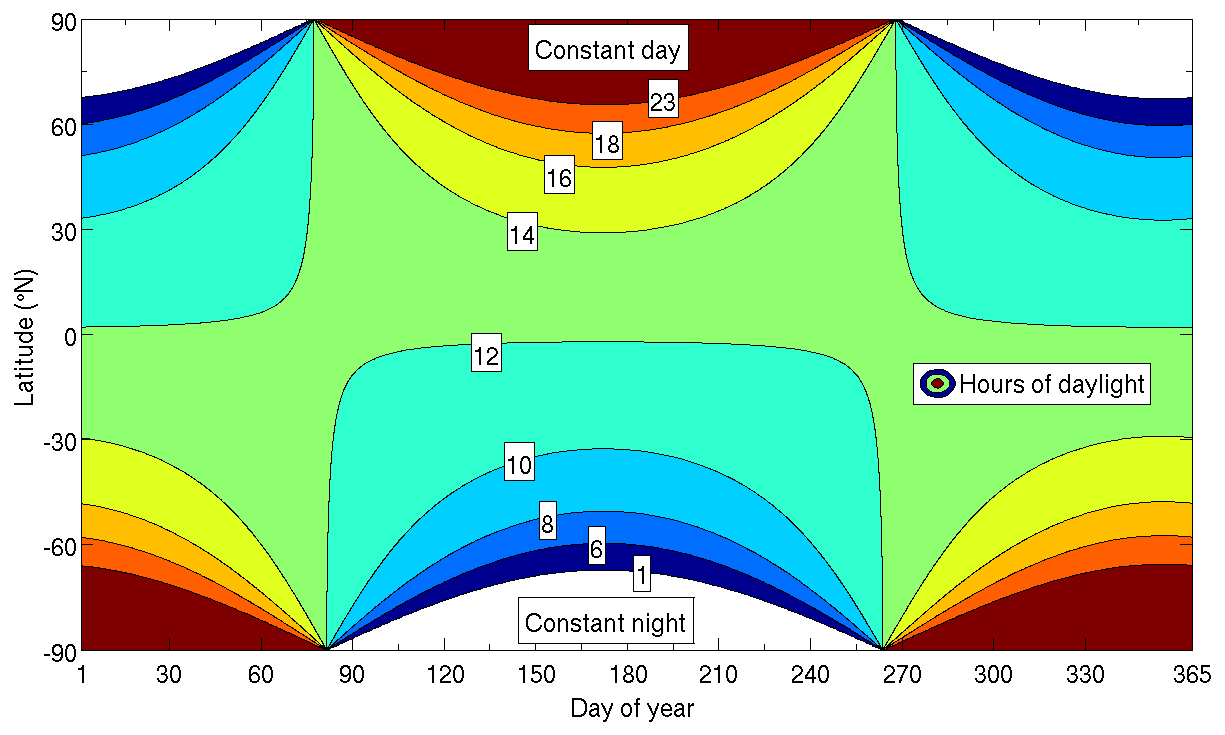
It's well known that Oca is day-length sensitive - that is, it will only form tubers during short days in autumn. However the various authorities on the subject do not present a completely uniform front on the subject when it comes to specific timings. Here are a few quotes from respected sources:

"The common Andean types generally require days shorter than 12 hours to initiate tuber formation..."

"The optimum day-length for tuber formation in oca is 9 hours..."

"...a few researchers think that low temperatures might sometimes be more important than day length for stimulating tuberization."

" ...the ones in New Zealand (most likely originating from southern Chile in the 1860s) are apparently unrestricted by daylength."

Day length vs. Latitude vs. day of year.
But Oca is grown in Ecuador, where days are constantly just over 12 hrs (depending on how you want to define sunrise and sunset) so in this special case day-length cannot be the trigger for tuberisation in the locally adapted varieties. With no astronomical seasons, perhaps meteorological seasons are significant, for example, the onset of a annual dry period.
It's never simple. Different varieties of oca along the length of the Andes will have evolved in response to different local conditions - so there is bound to be some variation in tuberisation triggers from variety to variety.

The furthest from the Equator that Oca is traditionally grown is about 42ºS, whereas I'm growing the crop at 51º30'N. Using the chart above, and taking say 10 hours as a threshold, my location has an earlier threshold date, but the days carry on briskly diminishing to about 8 hours, whereas at 40º latitude, the days diminish more gradually to a minimum of about 9.5 hrs. In practice, this means my location only gives a short period for tubers to form before the frost-risk of the very short days in mid winter.


Oca plants in mid-winter, with top-growth recently killed by frost.


So just like the potato when it was first brought to these latitudes, Oca needs to be given favourable microclimate conditions or protection to keep it growing into winter, well past the date when tuberisation begins. The (originally day-length sensitive) potato was adapted to European local conditions by breeding and selection, and Oca can be too, but until then it will not be reliable here as an unprotected field crop, as there is always a good chance that an early frost will finish them before the tubers are a usable size. See Oca versus Frost post.

And if the experts cannot agree on tuberisation conditions, what about my own direct observations:

-I notice tubers start to form here from about 20th October (day length c. 10.5 hrs).
-My 9 hour day-length threshold is around 13th November. Tubers do seem to be developing fairly quickly by this date.
I intend to check more thoroughly for tuberisation dates this year to see if there is any variation between varieties.

Come on tubers, what are you waiting for?


There's a whole-world daylength calculating calendar here if you want to check your own day-length dates.


Tuesday, 3 August 2010

The All-Tuber Polyculture Mound

In a quiet corner of 'my other plot' I'm trying another cultural method - a four foot wide mound with three different tuber crops grown closely together. I'm aiming for a low-maintenance easily-harvested dense ruck of tuberous productivity.


Unlike standard polycultures, a clear requirement for an all-tuber polyculture is that the crops involved should mature, and be harvested all at the same time, otherwise lifting one will disturb the roots of those remaining.
Oca, Yacon, and Chinese Artichokes together satisfy this criterion quite well, all normally being harvested after their top growth has been killed by frost.
I started in Spring by clearing the area of the previous Jerusalem artichoke crop (yeah, right!), and digging in a barrow-load of rough compost. This was more to improve water retention and aid soil friability (and hence make harvesting easier) than it was to boost fertility. On top of the mound goes one of my prized new variety purple Yacon, purportedly quick-maturing, but so far untried by me. It is certainly much more vigorous than my other 'standard' Yacon variety. Around this goes Oca, then on the outside edge are the Chinese Artichokes.

This little experiment could easily be scaled up to an informal linear raised bed (or 'lazy bed') if one wanted. It could even work on a commercial scale if suitable harvesting machinery was available.

With all the incorporated compost, thorough deep cultivation, and dense weed-suppressing foliage, this is also ideal as a once-and-for-all soil improvement method before turning ground over to no-dig culture.

Drought is the problem this season. All three crops are showing stress, but it will still be interesting to see what quantity of tubers can be got from this single square metre of ground.

Update 31/8/10
The drought has given way to a couple of weeks of pleasant showery weather. The soil moisture, no doubt helped by all that compost in the mound, has caused the Yacon to double in size. It is now seven foot wide and tall, topped with a lanky bouquet of flowers.
It is even suppressing a couple of late-breaking jerusalem artichoke volunteers, and I now fear for the productivity of the Oca and Chinese artichokes.
I either need a smaller Yacon, or a larger mound!

Update 1/11/10
The first air frost on 21/10 burned back the yacon foliage, but has not completely killed it. Under its protective canopy, the Oca plants have escaped damage, unlike those planted on open beds nearby.
A few days before the frost, I noted the yacon had grown to have a spread of nine feet!

Update 12/12/10
There has been freezing weather for a couple of weeks, and the plants are showing no sign of life. It's a dry day, so a good opportunity to exhume the contents of the mound.


First up is the Yacon. It's a big one! The Health & Safety Executive would have me use a hoist for this job, but after a bit of grunting I manage to get the crown in to a wheelbarrow solely by manual handling methods.
After washing, the useable tubers weigh in at 18 lb (8.2 kg), with another pound or two of small or damaged ones.

Delving around nearer the edges of the mound reveals the 'also rans' – a moderate scattering of mostly undersized Oca and Chinese artichoke tubers.
About 1.5 kg in total – which is as much as I can expect given that the plants have been camped under dense Yacon foliage for most of the growing  season.

CONCLUSIONS
This growing method was successful in terms of yield and low-labour, despite an unusually early frost. Next year it will be even easier; it will only be necessary to plant the Yacon, as there should be ample volunteer Oca and Chinese artichokes.

The imbalance in yield between the three crop species was caused by misjudging the vigour and final size of the particular variety of Yacon chosen. I mistakenly assumed it would be similar to the 'standard' Yacon that I have grown previously, and as a result the Oca and particularly the Chinese artichokes suffered from lack of light. However, a variety being too successful is a good fault, as they say.

It is an interesting and potentialy useful observation that the Oca were protected from the first frost by the Yacon foliage. Yacon, not being reliant on day length, can tuberise early, before sacrificially protecting undergrowing tender crops which have yet to fully tuberise. The partial defoliation lets through more light to ground level, and as long as there is not a second frost, the lower crops benefit.