Showing posts with label harvest. Show all posts

Sunday, 15 January 2012

Oca on the Show-Bench

Plant breeding and crop research may have their place in developing more productive edibles, but if you want to see some really big vegetables, what you need is a vegetable show.
Now, it's well known that these peculiarly British events can sometimes lead to 'poisonous rivalries, paranoia and sabotage' amongst participants, but there's no denying that they get results, whether it's by skulduggery, good husbandry, or top-secret fertiliser recipes of superphosphate and goat urine.
The problem is that these events are always held in the Summer; no use to growers of alternative tuber crops.

Never mind, I'll just hold my own show.

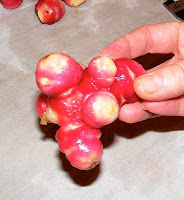
Here's my entry for the blue riband class:  "Oca, (5 tubers of a single variety)"...
I'm the only entry in the class, so I should have a good chance of a 'First' on this one. Unless you can upstage me that is.

Feel free to invent another competition class. How about"Biggest Oca", or "Oca, artistic arrangement".
Send in your jpegs and I'll post them here. We don't need the RHS to have a good time!

Oh, and no paranoia, sabotage, Photoshopping, or image morphing please. That just wouldn't be British.

5/2/12. And here is another entry. Again grown in West London, this time from Michael Willcocks, who's entering the 'Oca, Medley' section. Very respectable.
.

Saturday, 31 December 2011

Oca Harvest? Wait for It, Wait for It...

These are my main 'eating crop' of Oca...
It's more than two weeks since frost killed off the top growth, and received wisdom says now is the best time to harvest for maximum yield.
They certainly look as if they've completely snuffed it — until, that is, the top layer of dead foliage is pulled back...
The stems underneath are still green and succulent.
And below ground, roots and subterranean stems are also alive and well, continuing to build tubers...
An interesting approach would be to try to enhance this self-protecting effect by using closer plant spacing. The resulting denser foliage might provide sacrificial protection against significant frost in much the same way as a covering of horticultural fleece.
Using raised beds, earthing up, and planting under suitable taller crops are also cultural methods that may give partial frost protection.

It's a gamble to wait too long, as I found to my cost in 2009, but the weather has been mild and as a result vermin have not been digging up the tubers much. The ten-day forecast shows no imminent frost that would spoil tubers close to the surface, so on balance, I think it's worth waiting to give those tubers the maximum time to bulk up.

Tuesday, 13 December 2011

Assessing Some New Oca Varieties

Back in spring Frank Van Keirsbilck sent me a package of tubers to supplement my usual planting. These were grown from true seed, and thus relatively untested as productive varieties. Last week the weather was still holding frost-free and perfect for continued tuberisation, but I decided that lifting them early would be a good idea. They are going to be used solely for propagation material, so hanging on for maximum tuber size would be no advantage. In fact, lifting early would be better for identifying any less day-length-sensitive individuals. Also I was impatient.

This is "NZ003", his reference variety, which he also sent me, already showing a good yield...

The plants have been rigorously neglected all season as part of their selection process. They were planted in newly cleared ground, then left unweeded, unwatered and unattended.
By the way, if anyone doubts Oca's ability to outcompete weeds, have a look at this...
... Folding back the mass of foliage reveals completely clean soil.

Anyway, as would be expected there was a lot of variation in tuber appearance...

and also in productivity. A couple of plants expired during the growing season, some produced feeble crops, while others challenged the reference variety on productivity.  I've listed all the varieties, with their crop weight on this Google doc if you want to have a look at the details.

Of note would be 026 which produced this fasciated tuber...

...and 023, very productive, and many of whos tubers are characteristically elongated and possibly fasciated. This seems very interesting, and could be a route to increased tuber size.

014 and 008 yielded beautiful clean tubers...

This last one is not one of Frank's. It's grown from slips taken from the pink striped tuber that I got from Joel Carbonnel. Strangely the tubers are neither striped nor pink, but show varied colouration, and tiny flecks of purple at the ends of some eyes. It seems as if there is some instability going on, so this could be  one for development. In any case it's a good cropper.

Meanwhile my main bed of 'eating' varieties was frosted back the other night, so they'll be ready to lift in time for Christmas.

Sunday, 16 January 2011

Checking and Storing Oca Seed Tubers

A typical Oca harvest is a bit like a '60s Terry Thomas film -  sure to contain the odd rotter.
Oca tubers contain natural fungicides, and have good resistance to moulds and rots, but if they have been exposed to frost there is no escaping the fact that they are doomed to smelly putrefaction (have a look), and while most of the obvious casualties will have been spotted early when the tubers were lifted and washed, there are usually a few with minor damage that sneak through.
So now, a week or two after harvest, it's time to recheck stocks for any smelly surprises before storing them away until Spring.
And yes, several tubers (those on the plate) needed to be binned. If I had been desperate, I could have sliced off the affected parts, dipped the cut surface in wood ash, and the remaining material would probably have been fine for storing and replanting, but I'm in the fortunate position of having enough tubers.

As I sorted through, I was also carefully checking for any colour mutations, and when I saw the tuber below, just for a second I thought I had the potential to propagate a piebald strain.


Superficially, it looked like the area around one of the eyes had mutated to have black skin -  similar to the black Oca I obtained in the autumn.


But then I spotted an entry-hole leading to this tunnel. I think it's probably wireworm damage. I did notice one making a swim for it when I was washing the tubers.


With all the baddies removed, It's just a matter of selecting the good sized tubers, and putting them into storage. I use egg boxes (with lids closed to reduce drying out) as it helps to keep things organised, and makes occasional inspection easy...
...but the tubers seem to remain viable no matter how badly they are stored over winter; if left uncovered in a  heated room, they will shrivel up, but they will still sprout when the time is right.
If you are fussy about maintaining the visual appearance of the tubers, then aim to reduce the rate of moisture loss, for example by wrapping in newspaper, or a paper bag, or covering with almost-dry sand or sawdust, and placing them in an unheated room, or frost-free shed.
Be aware that if you go for the shed option, mice can develop a taste for them.

I'll start checking for shoots sprouting around late March.

Thursday, 6 January 2011

2010 Oca Crop - Harvest

In agriculture there is always a 'right time' to do things, but even with hindsight it would be hard to define the best time to lift the Oca this year. Getting a balance between delaying harvest to maximise tuber development, versus lifting early to avoid damage from frost is a difficult call at the best of times, but this year it was always going to be wrong; with a very early first-frost in October, and a record-breaking cold spell in December, this was not an 'Oca-year'.
The top growth has been dead for several weeks now, but harvest has been delayed either by snow cover, sub-zero temperatures, heavy rain, or pessimism-induced lethargy. However, the snow cover has been the saviour of the crop...
...it has insulated the ground during the really cold spell, so most tubers have escaped damage.
Tubers are generally small, and yield is well below that of previous years, but a few plants have produced a reasonable crop, while a couple have failed to make any tubers at all.
The unfavourable conditions have at least acted to highlight the productivity differences between varieties.  My planting stocks have been maintained, and there are enough extras for swapping and eating.

So a bad year, but mustn't grumble.

Saturday, 11 December 2010

Unimpressive Ulluco Harvest

Like the Oca, my Ulluco plants were hit by a light frost back in October (have a look).  Some plants died, while a few hung on to life until the recent really cold weather set in. The other day, I decided that I may as well see what was below ground.  I was expecting a poor crop, and that's just what I got...
... a handful of tubers not much bigger than beans. So no need to fetch the wheelbarrow then.

This handful wouldn't even make one meal, but they're satisfying enough as eye-candy to reward the light work of lifting them. They are just too good-looking to give up on yet.  At least I've maintained my planting stock for next year, and what's more, only the plants which survived the first frost produced tubers, so I now have the offspring of the marginally hardier individuals.

Day-length neutrality, or frost-hardiness  – I don't mind, either would do for me.

Tuesday, 3 August 2010

The All-Tuber Polyculture Mound

In a quiet corner of 'my other plot' I'm trying another cultural method - a four foot wide mound with three different tuber crops grown closely together. I'm aiming for a low-maintenance easily-harvested dense ruck of tuberous productivity.


Unlike standard polycultures, a clear requirement for an all-tuber polyculture is that the crops involved should mature, and be harvested all at the same time, otherwise lifting one will disturb the roots of those remaining.
Oca, Yacon, and Chinese Artichokes together satisfy this criterion quite well, all normally being harvested after their top growth has been killed by frost.
I started in Spring by clearing the area of the previous Jerusalem artichoke crop (yeah, right!), and digging in a barrow-load of rough compost. This was more to improve water retention and aid soil friability (and hence make harvesting easier) than it was to boost fertility. On top of the mound goes one of my prized new variety purple Yacon, purportedly quick-maturing, but so far untried by me. It is certainly much more vigorous than my other 'standard' Yacon variety. Around this goes Oca, then on the outside edge are the Chinese Artichokes.

This little experiment could easily be scaled up to an informal linear raised bed (or 'lazy bed') if one wanted. It could even work on a commercial scale if suitable harvesting machinery was available.

With all the incorporated compost, thorough deep cultivation, and dense weed-suppressing foliage, this is also ideal as a once-and-for-all soil improvement method before turning ground over to no-dig culture.

Drought is the problem this season. All three crops are showing stress, but it will still be interesting to see what quantity of tubers can be got from this single square metre of ground.

Update 31/8/10
The drought has given way to a couple of weeks of pleasant showery weather. The soil moisture, no doubt helped by all that compost in the mound, has caused the Yacon to double in size. It is now seven foot wide and tall, topped with a lanky bouquet of flowers.
It is even suppressing a couple of late-breaking jerusalem artichoke volunteers, and I now fear for the productivity of the Oca and Chinese artichokes.
I either need a smaller Yacon, or a larger mound!

Update 1/11/10
The first air frost on 21/10 burned back the yacon foliage, but has not completely killed it. Under its protective canopy, the Oca plants have escaped damage, unlike those planted on open beds nearby.
A few days before the frost, I noted the yacon had grown to have a spread of nine feet!

Update 12/12/10
There has been freezing weather for a couple of weeks, and the plants are showing no sign of life. It's a dry day, so a good opportunity to exhume the contents of the mound.


First up is the Yacon. It's a big one! The Health & Safety Executive would have me use a hoist for this job, but after a bit of grunting I manage to get the crown in to a wheelbarrow solely by manual handling methods.
After washing, the useable tubers weigh in at 18 lb (8.2 kg), with another pound or two of small or damaged ones.

Delving around nearer the edges of the mound reveals the 'also rans' – a moderate scattering of mostly undersized Oca and Chinese artichoke tubers.
About 1.5 kg in total – which is as much as I can expect given that the plants have been camped under dense Yacon foliage for most of the growing  season.

CONCLUSIONS
This growing method was successful in terms of yield and low-labour, despite an unusually early frost. Next year it will be even easier; it will only be necessary to plant the Yacon, as there should be ample volunteer Oca and Chinese artichokes.

The imbalance in yield between the three crop species was caused by misjudging the vigour and final size of the particular variety of Yacon chosen. I mistakenly assumed it would be similar to the 'standard' Yacon that I have grown previously, and as a result the Oca and particularly the Chinese artichokes suffered from lack of light. However, a variety being too successful is a good fault, as they say.

It is an interesting and potentialy useful observation that the Oca were protected from the first frost by the Yacon foliage. Yacon, not being reliant on day length, can tuberise early, before sacrificially protecting undergrowing tender crops which have yet to fully tuberise. The partial defoliation lets through more light to ground level, and as long as there is not a second frost, the lower crops benefit.

Sunday, 3 January 2010

Oca Weights & Measures - for Oca Anoraks Only


I need an objective method of assessing crop productivity so that different cultural methods and varieties can be impartially compared with each other. Weighing the tubers is the most obvious way to do this, but a single 100g tuber is far more desirable than 100g of tiddlers. Clearly weight alone should not be the yardstick.


So I will classify tubers as 'large' or 'small' as defined by whether they will go through a 25mm diameter hole, and weigh each group separately. Tubers with a minor axis diameter of 25mm are perfectly usable, but much below this, and they become a faff to lift and prepare.
This grading does not take as long as I expected, since only the borderline tubers actually need to be checked with the gauge.
My 'Oca Productivity Index' will reflect the fact that the small tubers are about half as useful and desirable as the large ones thus:

OPI = (weight of large tubers in kg) + ½(weight of small tubers in kg)

So the plant I lifted yesterday gave 1407g, of which 867g were large, and 540g small, giving an OPI of 1.14
This figure is convenient because it corresponds roughly to the weight (in kg) of useable tubers, and can be used 'per plant', 'per m²', etc.

Sometimes tubers grow 'daughter tubers'. No doubt plant physiologists will have a name for this, but I call it a damn nuisance, and I expect cooks do too. Anyway, for the purposes of weights and measures, all daughter tubers are snapped off (this can be done quite cleanly) and assessed separately. Otherwise the OPI will be flattered.

In case it shows up some significant factor, for each plant I am also recording the following:
  • Number of tubers, large
  • Number of tubers, small
  • Weight of largest tuber
  • Length of largest tuber
The photo at the top of this post shows the tuber that tops the table so far at 77g and 111mm.

Friday, 1 January 2010

2009 Crop - Harvest Results


31st December. It's 25 days since the first light frost, and 16 days since harder frost completely killed the foliage.
Having made the decision that the crop is ready to harvest, and having lifted the first plant, two things immediately sprang to mind. Firstly, it's a heavy crop, definitely more productive than last year. And secondly, a nagging doubt that the stems are not all as dead as they could be, and consequently the plants could still be transporting sap to the tubers.

It's possible to go too far with the waiting game, but you don't know where 'too far' is until you go there, so rather than lift all the plants now, I've decided to lift them individually at intervals of a day or two, weighing each plant's tubers, to see if there is any increase in the yield-per-plant over the next couple of weeks. If I'm right, it should plateau-off at some point, and this will give an indication of the optimum harvest time.

Weighing the tubers from the first plant was a pleasant surprise. 795g of large, and 405g of small tubers, giving a total of 1200g. (Definition of large and small tubers here). Annoyingly, I did not weigh last year's harvest, but I would estimate this year's to be almost double.
Update: 28/1/10 Results of the waiting game:
It started off so well, the crop from the first three plants supporting my hunch completely, but then the weather put a spanner in the works by freezing the ground for a couple of weeks. This caused the local wildlife to get extra hungry, some of whom developed a taste for Oca tubers. The result of this was an unknown quantity of tubers being scratched up and carried away, and the experiment was ruined.

Anyway, here are the limited results of the experiment, which allow some conclusions to be drawn:
Plant 1 (16 days after killing frost) 1200g  (OPI= 0.99)
Plant 2 (17 days after killing frost) 1217g  (OPI= 1.01)
Plant 3 (19 days after killing frost) 1407g  (OPI= 1.14)
Then came a period of snow and frozen conditions when no plants were lifted until:
Plant 4 (26 days after killing frost) 1155g  (OPI= 0.98)
More freezing weather with starving crows, rats, and feral ring-necked parakeets helping themselves:
Plant 5 (34 days after killing frost) 717g  (OPI=0.62)
finally, abandoning the experiment, I lifted all remaining plants. Weights include damaged tubers:
Plants 6 to 12 (43 days after killing frost) average yield 1038g (OPI not calculated)

Tubers exposed and damaged by birds.


Conclusions
  • Tuber weight may reach maximum at about 20 days after killing frost, or possibly even later. However the sample size here is so small that the data is not statistically significant, and no definite plateau was identified. It is quite possible that different temperature conditions would produce a different result.
  • Average yields of over 1kg, and peak yields approaching 1.5kg per plant are achievable in the south of the UK without using fertilisers, protected cropping, or labour-intensive cultural methods, even when bi-cropped.
  • Even if buried, tubers can be damaged by penetrating frosts, or raided by hungry birds, which can nullify any benefit of waiting for the purported optimum harvest time. Where freezing conditions are expected, it may be worth the extra work to earth-up, or provide other physical protection.  
  • The primary bi-crop (tomatoes) did not show any noticeable variation in yield relative to the control bed (which had the same spacing, but with French marigolds instead of Oca). N.B. the tomato yield was not weighed, so this conclusion is based on subjective judgement.

Friday, 27 November 2009

Introduction & 2008 Growing Season


Oca (Oxalis Tuberosa) is a promising root crop, rarely grown in the UK. I’m interested in it because it seems to offer potential for efficient bi-cropping and intercropping with more conventional vegetable crops.

I'm using this blog to share information gained from cropping experiments, as there seems to be little information currently available on this aspect of the crop, certainly in UK conditions.

I will not go into basic cultural requirements as this has been well covered elsewhere. I would recommend the following as good sources of information:

www.downtheplot.com/oca.php
www.realseeds.co.uk/unusualtubers.html (who also sell seed tubers).
www.pfaf.org/database/plants.php?Oxalis+tuberosa
www.wildchicken.com
thevegetablegarden

Certain properties of Oca make it suitable for filling vacant gaps in the four-dimensional space of a highly productive, low-work vegetable-growing system (the fourth dimension is time!). These properties are:
  • Apparently tolerant of competition from other crops. 
  • Harvested during winter, when there are few other fresh vegetables available. 
  • Occupies little space until late summer. 
  • Makes maximum growth late in the season when space is more available. 
  • Acts as an effective moisture-retentive living mulch during late summer. 
  • Acts as a protective ground cover during early winter. 
  • Described as being unaffected by pests and diseases.
My Style of Gardening.
I'd describe my gardening style as: organic, intensive, urban-salvage, no-dig. I’m particularly interested in overlapping crops, where one is sown or planted out before the previous one has matured. This requires careful timing to minimise competition, but can be far more space-efficient than simple bi-cropping, catch-cropping, or companion planting alone.

An example of this intensive method is shown below. A bed with ripening spring-planted onions has recently transplanted sweetcorn estblishing between them. Once the onions are lifted, Winter squash will be transplanted between the corn. The squash and corn will be cleared in time to sow an over winter green-manure crop.
With a green-manure crop also preceding the sequence, the soil has been protected for the entire year, and produced three crops during the season, all without digging.

First Experiences with the Crop, 2008


Oca (centre) fighting it out with peas, beans, corn and lettuce. Mid June.

I had read all I could about Oca, so knew what to expect in terms of ultimate space requirements and timing. I planted the seed tubers in pots, then spaced them either side of a 4ft wide legume bed consisting of a 2mtr high central net, with climbing French beans and tall peas. Either side of the central divider was planted with alternating sweetcorn, and the Oca plants, with lettuces early in the season just for good measure.
4th December. All other crops have been cleared from the bed, and the first light frost has cut down the foliage.

Tubers are forming, but they are still tiddlers.


A week later (12th Dec). The stems have died back. I decide to lift one plant, but the tuber size is still disappointing.
(1st January) The stems have been fully killed off by more frost. Harvest time! ...

... And the tubers have doubled in size
So What did I learn?

The single most important way of increasing the yield is to delay harvesting long enough. While lifting the tubers I noticed that, even on the 1st of January, the stems which were below ground were still slightly green and fleshy, so I suspect the tubers might have continued to swell if they had been left still longer. This is much later than is recommended elsewhere, but in this urban environment, frost comes late, which favours the crop's productivity.
As suspected, competition with (or from) other crops is not great, making it ideal for bi and tri-cropping, and crop-overlap. 

The moderate yield per area does not justify it as a monoculture crop, by my standards.

Contrary to received wisdom, it does suffer from at least one pest - there was some damage to exposed tubers late in the year - probably pigeons, crows, or ring-neck parakeets. But no signs of any disease.

The plants ultimately require a lot of space. Two rows on a 4ft bed obstructed the adjacent paths by late summer.