Showing posts with label Oca Productivity Index. Show all posts

Wednesday, 2 June 2010

Oca - Be Erect, not Supine!

Oca plants start off fine and upstanding, but then they always over-extend themselves and flop over. The newly horizontal stems then send out secondary shoots, upright at first, but they too collapse if they get long enough.

Once day-length reduces to a certain critical point, new side shoots start to stolonate, heading downwards and forming tubers, at or just above ground level.


In Tubers - Big and Few or Small and Many? I made the observation that these tubers never reach the size of those that form wholey underground around the original planting tuber, and I speculated that preventing these stem tubers from forming might lead to bigger underground tubers.
I've since looked at photos of traditional Andean cultural methods. Oca is earthed up, but the ridges are much bigger than those commonly used for potatoes - perhaps two feet high - so big that the stems are held fairly upright even when the plants are large (have a look). Perhaps this is the main benefit of earthing up - rather that the supposed frost protection effect, or to 'encourage stolon formation'.
I'm guessing that the above-ground tubers won't form if the stems do not sense soil nearby. The plant's reserves will have to be relayed to the underground tubers, increasing their size, instead of being dispersed across all of those tiddlers that mostly end up as bird food.

As a simple test, I'll try a few plants growing up through a wire mesh cage. This should be enough to support the stems and maybe keep them from stolonating.

Let's see how it goes.

Here's the view on the 4th July,


...and on the 1st of September.

On the 21st October there was an unusually early frost, killing off other oca plantings, but this group escaped fatally serious damage, presumably by being above the coldest air.
It produced a reasonable crop (interestingly, with almost no tuber stems) but I had no other plants left to compare against.
If nothing else, this method allows Oca to be grown in a much smaller space than if they are allowed to sprawl.

Sunday, 3 January 2010

Oca Weights & Measures - for Oca Anoraks Only


I need an objective method of assessing crop productivity so that different cultural methods and varieties can be impartially compared with each other. Weighing the tubers is the most obvious way to do this, but a single 100g tuber is far more desirable than 100g of tiddlers. Clearly weight alone should not be the yardstick.


So I will classify tubers as 'large' or 'small' as defined by whether they will go through a 25mm diameter hole, and weigh each group separately. Tubers with a minor axis diameter of 25mm are perfectly usable, but much below this, and they become a faff to lift and prepare.
This grading does not take as long as I expected, since only the borderline tubers actually need to be checked with the gauge.
My 'Oca Productivity Index' will reflect the fact that the small tubers are about half as useful and desirable as the large ones thus:

OPI = (weight of large tubers in kg) + ½(weight of small tubers in kg)

So the plant I lifted yesterday gave 1407g, of which 867g were large, and 540g small, giving an OPI of 1.14
This figure is convenient because it corresponds roughly to the weight (in kg) of useable tubers, and can be used 'per plant', 'per m²', etc.

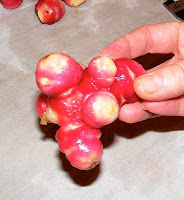
Sometimes tubers grow 'daughter tubers'. No doubt plant physiologists will have a name for this, but I call it a damn nuisance, and I expect cooks do too. Anyway, for the purposes of weights and measures, all daughter tubers are snapped off (this can be done quite cleanly) and assessed separately. Otherwise the OPI will be flattered.

In case it shows up some significant factor, for each plant I am also recording the following:
  • Number of tubers, large
  • Number of tubers, small
  • Weight of largest tuber
  • Length of largest tuber
The photo at the top of this post shows the tuber that tops the table so far at 77g and 111mm.