I need an objective method of assessing crop productivity so that different cultural methods and varieties can be impartially compared with each other. Weighing the tubers is the most obvious way to do this, but a single 100g tuber is far more desirable than 100g of tiddlers. Clearly weight alone should not be the yardstick.

So I will classify tubers as 'large' or 'small' as defined by whether they will go through a 25mm diameter hole, and weigh each group separately. Tubers with a minor axis diameter of 25mm are perfectly usable, but much below this, and they become a faff to lift and prepare.
This grading does not take as long as I expected, since only the borderline tubers actually need to be checked with the gauge.
My 'Oca Productivity Index' will reflect the fact that the small tubers are about half as useful and desirable as the large ones thus:
OPI = (weight of large tubers in kg) + ½(weight of small tubers in kg)
So the plant I lifted yesterday gave 1407g, of which 867g were large, and 540g small, giving an OPI of 1.14
This figure is convenient because it corresponds roughly to the weight (in kg) of useable tubers, and can be used 'per plant', 'per m²', etc.
Sometimes tubers grow 'daughter tubers'. No doubt plant physiologists will have a name for this, but I call it a damn nuisance, and I expect cooks do too. Anyway, for the purposes of weights and measures, all daughter tubers are snapped off (this can be done quite cleanly) and assessed separately. Otherwise the OPI will be flattered.
In case it shows up some significant factor, for each plant I am also recording the following:
- Number of tubers, large
- Number of tubers, small
- Weight of largest tuber
- Length of largest tuber
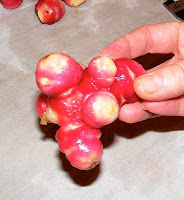
The photo at the top of this post shows the tuber that tops the table so far at 77g and 111mm.


 which contains some eye-opening scale drawings of various vegetable root zones in the section 'Intercropping Below Ground - The Shape of Roots', which are helpful when visualising the amount of competition between plant root systems. From observation of the plants I've lifted, Oca roots seem to have a similar range to tomatoes - 3 feet radius by 4 feet deep, but with most of the fibrous rootball close to the planting tuber. The fleshy roots, one of which grows from each eye, extend further and send out a more sparse network of fine root hairs which are difficult to follow in the soil, so it's hard to say exactly how far they spread.